




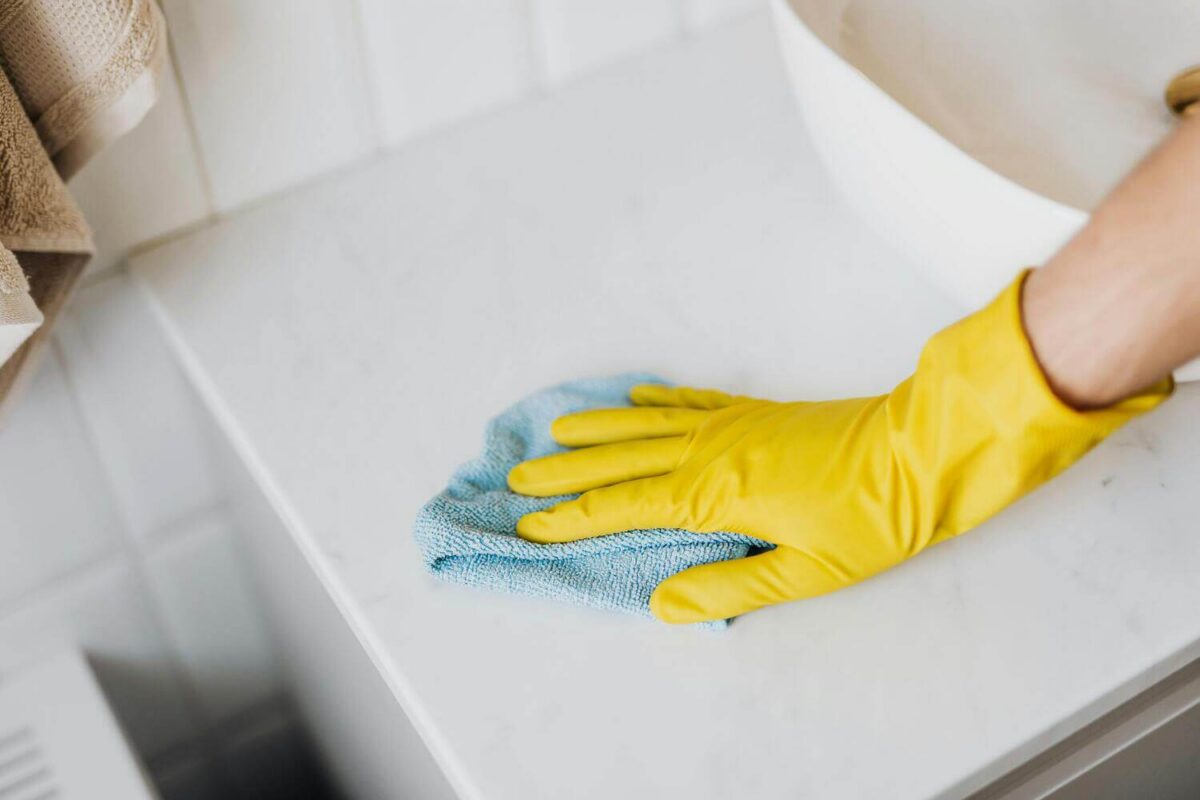
Latex, PVC or Nitrile Cleaning Gloves — How to Choose the Right Pair
Latex, PVC or Nitrile Cleaning Gloves — How to Choose the Right Pair
The Short Answer
Choose latex if you want maximum flexibility, tactile feel, and durability for general household cleaning. Choose PVC if you have a latex allergy, need a close second-skin fit for precision work, or want a clean-environment glove for food preparation. Choose nitrile if you regularly handle oils, grease, strong disinfectants, or automotive chemicals. Neoprene is for the most aggressive industrial chemicals and is rarely needed for home or commercial cleaning.
What to Look for Before You Choose Cleaning Gloves
Most people look at material first and miss five other factors that often matter more in practice.
Thickness determines durability and feel. Measured in millimetres or mils (1 mil = 0.025 mm), thicker gloves resist punctures and last longer but reduce sensitivity. For household cleaning, 0.30–0.50 mm is the practical range. Below 0.25 mm and you are working with disposable-grade material — adequate for a single task, not for repeated use. Above 0.80 mm, manual dexterity starts to suffer noticeably.
Cuff length is the most overlooked selection criterion. A 30 cm cuff protects the lower forearm when reaching into deep sinks, buckets, and mop water — the single most common way cleaning chemicals reach bare skin. Shorter cuffs (under 25 cm) leave the wrist exposed. If your cleaning work involves buckets, deep sinks, or spraying, prioritise cuff length at least as much as material.
Interior lining changes everything for comfort. An unlined glove in latex or PVC becomes uncomfortable within 15–20 minutes due to heat and perspiration. A cotton flock lining absorbs moisture, prevents the glove from sticking to skin, and makes extended work sessions significantly more comfortable. If you are cleaning professionally or for more than 30 minutes at a stretch, look specifically for a flocked or lined interior.
Powdered vs. powder-free matters more than most buyers realise. Powdered gloves use corn starch or talc inside to make them easier to pull on. The problem is that the powder carries latex proteins into the air when the glove is snapped on, which can trigger allergic reactions in sensitive individuals nearby — not just the wearer. Powder also leaves residue on surfaces and hands that is unsuitable for food environments and sterile work areas. For cleaning use, powder-free is the correct default.
Powdered gloves are now banned in medical devices in the EU and US for exactly these reasons.
CE certification is the only objective measure of what a glove actually protects against. Any glove sold in the EU as a protective product must carry a CE mark and belong to one of three categories. Category I covers minimal risk only — no chemical breakthrough testing required. Category II is independently assessed against general PPE requirements. Category III requires third-party testing against EN 374 chemical and biological standards and is appropriate for tasks where chemical exposure could cause serious or irreversible harm. This is about the severity of risk, not simply whether you are a professional or home user. A full explanation of what these categories mean in practice appears further down this guide.
Surface texture affects grip but is secondary to the above. A diamond or embossed pattern on the palm and fingers helps hold wet, slippery objects — useful for dishes, bottles, and cleaning equipment. Smooth gloves are adequate for dry tasks but become unreliable with soapy water.
Material Comparison at a Glance
| Feature | Latex (Natural Rubber) | PVC (Vinyl) | Nitrile | Neoprene |
|---|---|---|---|---|
| Allergy risk | Yes — Type I latex allergy | None | None (accelerator sensitivity possible) | Rare (accelerator sensitivity) |
| Flexibility and feel | Excellent — stretches to hand shape | Good — close-fitting in quality models | Good — slightly stiffer than latex | Moderate |
| Tactile sensitivity | Best of all materials | Good | Slightly less than latex | Moderate |
| Chemical resistance | Good against dilute acids, alkalis, detergents | Good against dilute acids and alkalis; limited against organic solvents | Excellent against oils, grease, solvents, most acids | Excellent — broadest chemical range |
| Puncture and tear resistance | Good | Moderate | Very good — fails visibly | Good |
| Lining available | Yes (cotton flock) | Yes (slip-on treatment) | Yes (cotton flock) | Yes |
| Reusable | Yes | Yes | Yes | Yes |
| Food contact approved | Yes (specific models) | Yes (phthalate-free models; avoid with fatty foods) | Yes | Varies by model |
| CE Category III available | Yes | Yes | Yes | Yes |
| Best for | General household cleaning, dishes, mopping, gardening | Latex allergy, food prep, precision tasks, clean environments | Oils, grease, strong disinfectants, automotive work | Heavy industrial chemicals, aggressive solvents |
| Avoid when | Latex allergy confirmed; working with oils or petroleum solvents | Heavy abrasion; strong organic solvents such as acetone; handling fatty foods | Ketones, oxidising acids, organic nitrogen compounds | Cost-sensitive everyday use |
Gloves by Task — Quick Reference
Match your task to the table below. The deep-dive sections that follow explain the reasoning behind each recommendation.
| Task | Recommended material | Notes |
|---|---|---|
| General household cleaning | Latex or PVC | Latex for durability and feel; PVC for latex allergy sufferers |
| Dishwashing | Latex | Cotton flock lining prevents sweaty hands; 30 cm cuff keeps water off the forearm |
| Bathroom cleaning with bleach or disinfectant | PVC or nitrile | Latex degrades faster with repeated bleach contact |
| Kitchen and food preparation | Latex or nitrile | PVC is suitable for general kitchen cleaning but not for handling fatty foods; always verify food-contact certification on the packaging |
| Professional and commercial cleaning | Latex or PVC, CE Cat. III for high-risk tasks | Cat. III required where chemicals could cause serious harm; cuff of at least 30 cm recommended |
| Mopping and floor cleaning | Latex | Durability and grip for repeated wringing |
| Window and glass cleaning | PVC or latex | Close fit and tactile feedback help avoid smearing |
| Automotive and mechanical work | Nitrile | Resistance to oils, fuels, and lubricants that degrade latex and PVC |
| Heavy chemical handling — labs and industrial | Nitrile or neoprene | Check the chemical compatibility data sheet for specific substances |
| Sensitive skin or known glove reactions | Accelerator-free nitrile or cotton-lined latex | See the accelerator allergy section below before choosing |
| Gardening | Latex | Good mechanical protection and comfortable for extended outdoor wear |
When the task involves disinfecting surfaces from viruses or bacteria, nitrile is the recommended material — it offers reliable resistance to the lactic acid, alcohol, and quaternary ammonium compounds used in most certified disinfectants. For the full disinfection method, see our guide on safely disinfecting surfaces from viruses.
Latex (Natural Rubber) — Deep Dive
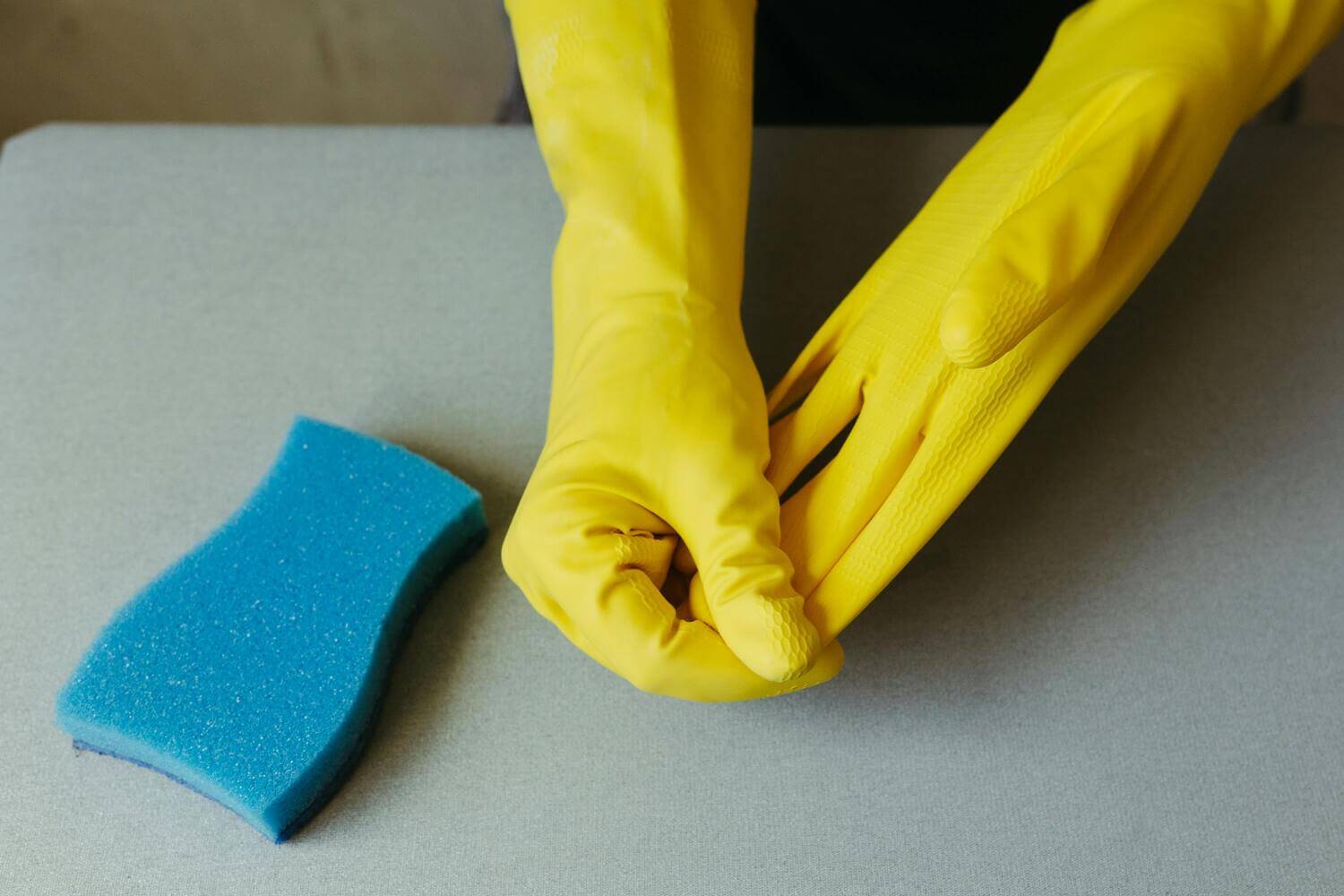
Latex comes from the sap of the Hevea brasiliensis rubber tree. It has been the dominant household glove material for decades because natural rubber combines high elasticity, good mechanical strength, and exceptional comfort in a single material. When vulcanised — heat-treated with sulphur — it becomes durable enough for repeated heavy use while retaining the stretch that makes it comfortable to wear.
Latex gloves conform tightly to the shape of the hand, transmitting grip and pressure very accurately. You can feel a slippery dish, sense when a surface is clean, and handle small or intricate objects without the clumsiness that comes with a looser-fitting material. This tactile sensitivity — better than any synthetic alternative — is why latex remains the first choice for dishwashing, detailed cleaning, and any task where manual dexterity matters. A well-made reusable latex glove with cotton flock lining will typically last weeks to months depending on frequency and the chemicals involved, making the cost-per-use considerably lower than repeated disposable alternatives.
Chemical resistance
Latex performs well against the chemicals encountered in most household and commercial cleaning: dilute acids such as bathroom descalers, dilute alkalis in general cleaners, detergents, and most standard disinfectants. EN 374 Type C certification — the standard carried by the Coverguard Eurodip 5030 — confirms resistance against chemical splashes including sodium hydroxide and sulphuric acid at breakthrough times exceeding 480 and 10 minutes respectively.
Where latex falls short is with oils and petroleum-derived products (mineral oils, fuels, lubricants), aromatic solvents, and strong organic compounds. These penetrate natural rubber relatively quickly. For those specific chemicals, nitrile or neoprene is the correct choice.
The allergy question
Latex allergy is the most important limitation of natural rubber gloves, and it is worth understanding the distinction between two types that are often confused.
Type I (IgE-mediated) is an immediate immune response triggered by proteins in the natural rubber itself. Symptoms range from skin irritation and hives to, in rare cases, anaphylaxis. If you or anyone using the gloves has a confirmed Type I latex allergy, latex gloves must be avoided entirely.
Type IV (contact dermatitis) is a delayed reaction — not to the latex proteins themselves but to chemical accelerators used during manufacturing, particularly thiurams and carbamates. It typically appears as dry, itchy skin that develops gradually after extended wear. Importantly, most standard nitrile gloves use the same accelerators and can cause the same reaction. Switching to a cotton-flocked latex glove (where the lining acts as a physical barrier) or to accelerator-free nitrile often resolves this. See the dedicated section on accelerator reactions below.
A cotton flock lining reduces but does not eliminate the risk of Type I reaction. For confirmed allergy, the material itself must change.
Latex gloves are ideal for:
- Dishwashing and general kitchen cleaning
- Bathroom and toilet cleaning with standard household products
- General mopping and floor cleaning
- Gardening and light outdoor maintenance
- Food preparation (food-contact approved models)
- Professional commercial cleaning at CE Category III level
Latex gloves are not recommended for:
- Anyone with a confirmed or suspected Type I latex allergy
- Work with mineral oils, fuels, or lubricants
- Prolonged contact with strong solvents or aromatic compounds
Our latex cleaning glove: Coverguard Eurodip 5030 — CE Category III, EN 374 Type C, cotton flock lining, 30 cm cuff, food-contact approved, sizes 7–10.
PVC (Vinyl) — Deep Dive

PVC stands for polyvinyl chloride — a synthetic polymer produced from ethylene and chlorine. As a glove material it is fundamentally different from latex: no natural proteins, no rubber-derived compounds, and no allergy risk to the vast majority of users. In thin, high-quality formulations, PVC can be made flexible and close-fitting enough to provide a second-skin feel that rivals latex for precision work.
A note on terminology: “vinyl” vs “PVC”
These terms are used interchangeably in the market, but in practice they describe two very different products. When buying guides say “vinyl gloves offer limited protection,” they mean loose-fitting disposable vinyl — typically 0.08–0.12 mm thick, designed for a single use, with minimal chemical resistance. A purpose-made reusable PVC household glove is a different product entirely. The SHOWA B0700R, for example, is 0.30 mm thick, CE-certified to EN 374, and chemically tested against sodium hydroxide and sulphuric acid with breakthrough times measured in hours. Disposable-focused comparisons do not apply to this category of glove.
Why cleanness is the defining advantage
Quality PVC cleaning gloves shed no fibres, no lint, and no particles. This makes them the preferred choice in food production, pharmaceutical environments, clean rooms, and anywhere the work surface cannot be contaminated by the glove itself. The absence of a cotton flock lining in unlined versions also means there is no biological material inside the glove to degrade or harbour bacteria over repeated uses.
The slip-on treatment inside quality PVC gloves solves the main comfort problem of unlined synthetic gloves: they go on and come off easily even when hands are slightly damp, which is practical for tasks where you need to remove gloves quickly and re-glove between areas.
Chemical resistance and the food contact caveat
Quality PVC certified to EN 374 performs well against dilute acids and alkalis, water-based cleaning products, disinfectants, and common household chemicals. Breakthrough testing of the SHOWA B0700R against sodium hydroxide 40% shows a penetration time exceeding 480 minutes — eight hours of continuous contact before the chemical reaches skin.
There are two limitations worth knowing. First, strong organic solvents — acetone, toluene, MEK, and similar compounds — penetrate PVC relatively quickly. For solvent-based products, use nitrile. Second, PVC in contact with high-fat foods (butter, oils, raw meat with high fat content) can allow plasticiser migration even in phthalate-free formulations — a property of the PVC matrix itself rather than specifically the plasticiser type. For direct handling of fatty foods, latex or nitrile is the safer choice. PVC remains fully appropriate for general kitchen cleaning, surface wiping, and dishwashing.
PVC gloves are ideal for:
- Anyone with latex allergy or latex sensitivity
- Food-service cleaning and surface work (using food-contact certified models)
- Pharmaceutical, laboratory, and clean-room work
- Precision cleaning where tactile feedback matters
- Professional cleaning requiring a lint-free glove
- Situations requiring frequent glove changes
PVC gloves are not recommended for:
- Heavy abrasive scrubbing requiring maximum puncture resistance
- Work with strong organic solvents (acetone, toluene, MEK)
- Prolonged handling of high-fat foods
- Prolonged immersion in highly concentrated industrial chemicals
Our PVC cleaning glove: SHOWA B0700R — CE Category II, EN 374 Type C, 30 cm cuff, phthalate-free PVC, lint-free, food-contact suitable, sizes 7–10.
Nitrile — Deep Dive
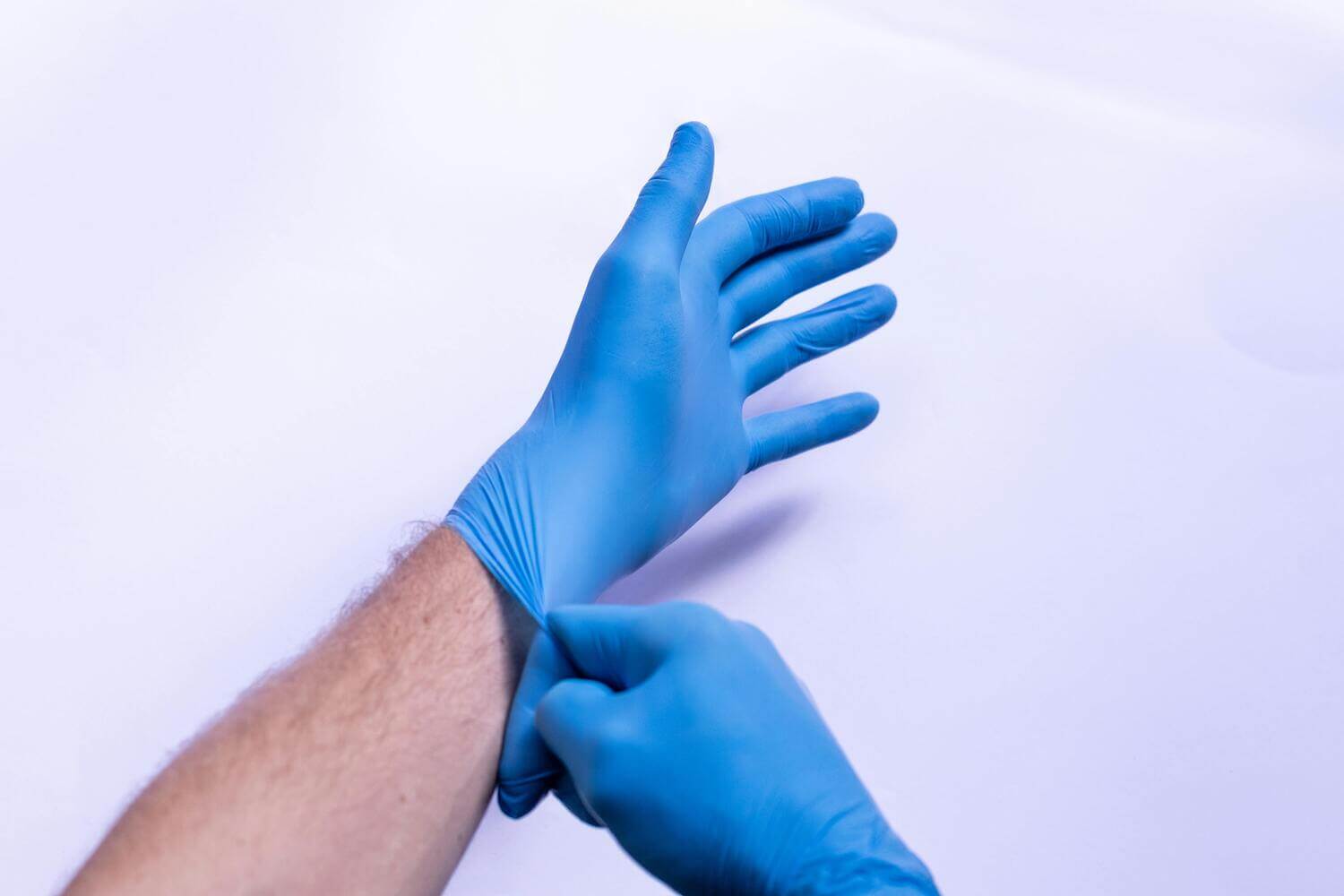
Nitrile (acrylonitrile butadiene rubber, or NBR) is a synthetic rubber originally developed as an allergy-safe alternative to latex. Since the 1990s it has become the dominant material in disposable medical and industrial gloves worldwide. Synthesised from petroleum-derived compounds, it has consistent quality and a longer shelf life than natural rubber — typically five years stored versus three years for latex.
The defining characteristic of nitrile is its resistance to oils, greases, and petroleum-derived compounds — areas where both latex and PVC fall short. Nitrile also has higher puncture resistance than latex at equivalent thickness, and it fails visibly by tearing rather than developing microscopic perforations. That means you know immediately when a glove has been compromised, which matters in any safety-sensitive context.
For cleaning applications, nitrile becomes the correct material when the chemicals involved go beyond standard household products — concentrated disinfectants, solvent-based cleaners, automotive products, or industrial-grade degreasers. It is slightly less tactile than latex and less elastic, which can make extended wear less comfortable. The main chemical limitation is ketones (acetone, MEK) and oxidising acids, which penetrate nitrile relatively quickly — for those, neoprene or butyl rubber is required.
The accelerator allergy problem
This is one of the most frequently misunderstood issues in glove selection. Many people who believe they have a latex allergy are actually reacting to chemical accelerators — thiurams and carbamates — used during glove manufacturing. The key difference is timing: a true Type I latex reaction appears within minutes of putting on the glove. An accelerator reaction (Type IV contact dermatitis) develops gradually, typically 12–48 hours after exposure, as dry, itchy, or cracked skin on the back of the hands and fingers.
The critical complication is that most standard nitrile gloves use the same accelerators as latex gloves. Switching from latex to standard nitrile will not resolve a Type IV reaction — it simply removes the latex protein and replaces it with the same triggering compound. The correct solution is accelerator-free nitrile, which uses an alternative curing chemistry. These are available from several glove manufacturers and are worth specifically seeking out if someone has persistent skin reactions with any standard glove. Alternatively, a cotton-lined latex or PVC glove where the lining creates a physical barrier between the material and the skin can also break the contact cycle.
Nitrile gloves are ideal for:
- Automotive cleaning and degreasing
- Industrial cleaning with solvent-based products
- Concentrated disinfectants and sterilisation agents
- Food processing environments with significant oils and fats
- Tasks where the chemical resistance data for latex or PVC does not confirm compatibility
Nitrile gloves are not recommended for:
- Contact with ketones (acetone, MEK) or oxidising acids
- Users with severe accelerator allergies (unless specifically accelerator-free)
Neoprene — Brief Overview
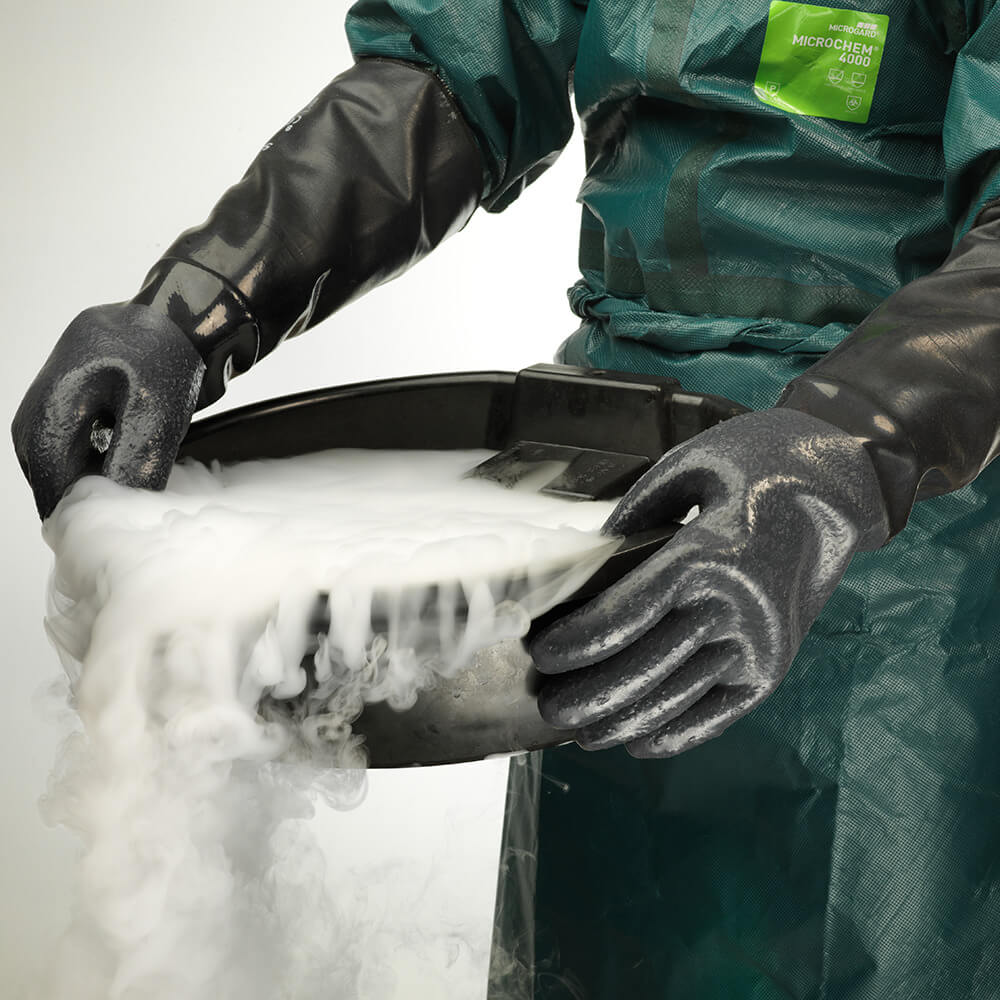
Neoprene (polychloroprene) has the broadest chemical resistance of the four materials covered here. It resists acids, alkalis, most organic solvents, oils, and many compounds that degrade nitrile, latex, or PVC. For most household and commercial cleaning, it is not necessary — heavier, less flexible, and considerably more expensive than the alternatives. Neoprene is the right choice for industrial or laboratory work involving highly aggressive chemicals where neither nitrile nor PVC provides sufficient protection. If your cleaning work involves substances like concentrated acetic acid, glycol ethers, or peroxides, neoprene is worth investigating.
Reusable vs. Disposable — Which Should You Choose?
Disposable gloves have a genuine place in cleaning, but they are often used by default for tasks where a reusable glove is the better choice on every measure — cost, protection level, and environmental impact.
Disposable gloves make sense when: the task is short and high-contamination risk (changing a bin liner, handling raw meat, cleaning a toilet in a shared facility), the gloves will contact surfaces in a medical or sterile environment, the gloves are shared between different users, or the task involves biohazard material that cannot be safely cleaned off a glove.
Reusable gloves make more sense when you clean regularly. A quality reusable latex or PVC glove costs €3–8 per pair and, with proper care, lasts 50–100 uses — roughly €0.03–0.16 per use. A box of 100 nitrile disposables costs approximately €15–25, giving a cost per pair of €0.15–0.25, used once and discarded. For anyone cleaning more than twice a week, reusable gloves pay for themselves within a month.
For professional cleaning operations, the economics are even clearer. A cleaner using disposable nitrile gloves and changing them 8–10 times per shift generates roughly €300–450 in glove costs per year for that one employee. A pair of reusable CE-certified gloves at €6, lasting six weeks, costs around €52 per year — an 80–85% reduction with better protection, since reusable models are typically 0.30–0.50 mm thick versus 0.08–0.15 mm for disposables.
Protection level is the other factor. Disposable gloves are designed for short, single-use tasks. A disposable glove was not built for 20 minutes of scrubbing a shower, repeated wringing of a mop, or sustained contact with concentrated descaler. For any cleaning session lasting more than a few minutes, a reusable glove provides meaningfully better mechanical and chemical protection.
Colour-Coding and Cross-Contamination Prevention
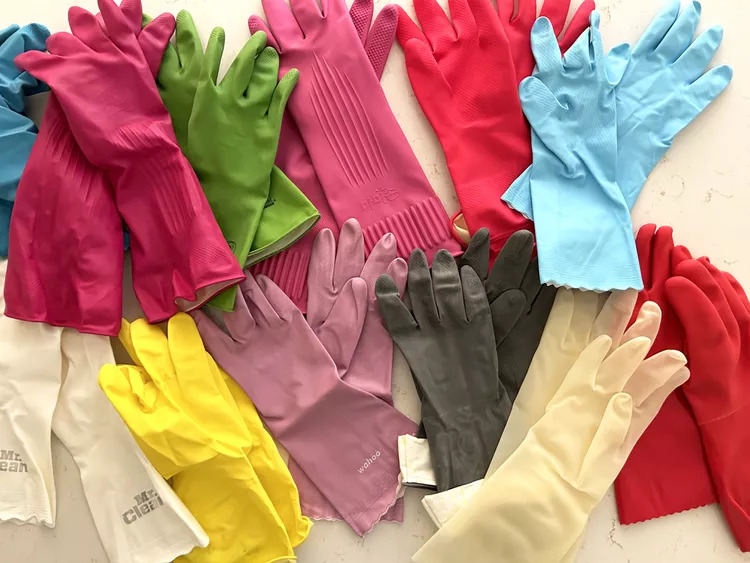
Using the same pair of gloves across all cleaning tasks is not just a hygiene lapse — it actively transfers contamination from one surface to another. A glove used to clean a toilet and then used immediately to wipe a kitchen counter or prepare food carries pathogens from the first environment into the second. This risk is easily managed with a simple colour-coded system.
The widely followed professional cleaning protocol assigns glove colour by area:
| Colour | Area | Typical tasks |
|---|---|---|
| Red | Toilets and urinals | Toilet bowl, cistern, urinal cleaning |
| Yellow | General bathroom and washroom | Sinks, taps, mirrors, bathroom surfaces |
| Blue | General areas and offices | Desks, doors, general surfaces, mopping |
| Green | Food preparation and kitchen | Food handling, kitchen surfaces, catering |
| White | Sensitive or sterile areas | Pharmaceutical, laboratory, cleanroom |
For home use, a strict colour protocol is not necessary — but the principle still applies. Keep one clearly marked pair for bathroom and toilet work and a separate pair for kitchen use. Never use the same pair across both areas without washing the gloves thoroughly in between, and even then, avoid the crossover for food contact surfaces. The few seconds it takes to switch pairs eliminates a genuine contamination risk.
What CE Categories and EN 374 Actually Mean
The certification markings on a glove package are not decoration. They tell you exactly how much testing the glove underwent and what it was confirmed to protect against. Most buying guides skip this entirely — here is what the labels mean in plain language.
CE Categories I, II and III
Category I means the manufacturer self-declares conformity. No independent testing is required. Appropriate for minimal risks — light gardening, general cleaning with mild detergents. Not appropriate for regular chemical contact.
Category II means the glove has been independently assessed against the general PPE requirements of EN ISO 21420. More reliable than self-declaration, but chemical-specific breakthrough testing is not required.
Category III is the highest classification. It requires independent third-party testing against the specific performance standard for the risk claimed — for chemical-resistant gloves, that means EN 374. Category III is appropriate where chemical exposure could cause serious or irreversible harm: concentrated acids, strong alkalis, biohazard environments. It is not automatically required for all professional cleaning — a commercial office cleaner using standard detergents and a mop does not necessarily need Category III gloves. But a cleaner working with concentrated disinfectants, descalers, or industrial degreasers does.
EN 374 Types A, B and C
Within EN 374, gloves are classified by how many chemicals they successfully resist at specified breakthrough times. Type C confirms the glove resists penetration under air and water pressure — protection against accidental chemical splashes, with no minimum breakthrough time requirement. Type B means the glove was tested against at least three of the 18 standard chemicals in the EN 374 list, achieving breakthrough times of 30 minutes or more for each. Type A is the highest classification: tested against at least six standard chemicals, each with breakthrough times of 30 minutes or more.
For household and most commercial cleaning, EN 374 Type C provides the appropriate level of protection. The specific chemicals tested are identified by letter codes on the packaging — K indicates sodium hydroxide 40%, L indicates sulphuric acid 96%, for example. These codes let you verify the glove was tested against the chemicals you will actually be using.
EN 374-5 — microorganism protection
EN 374-5 certification confirms the glove provides protection against bacteria, fungi, and viruses. This is relevant for professional cleaning in healthcare facilities, food processing, and sanitation environments where biological contamination is a risk alongside chemical exposure.
How to Find the Right Size
Gloves that are too small restrict blood flow and cause fatigue. Gloves that are too large shift on the hand, reduce grip accuracy, and increase the risk of snagging on equipment. Neither performs the way it was designed to.
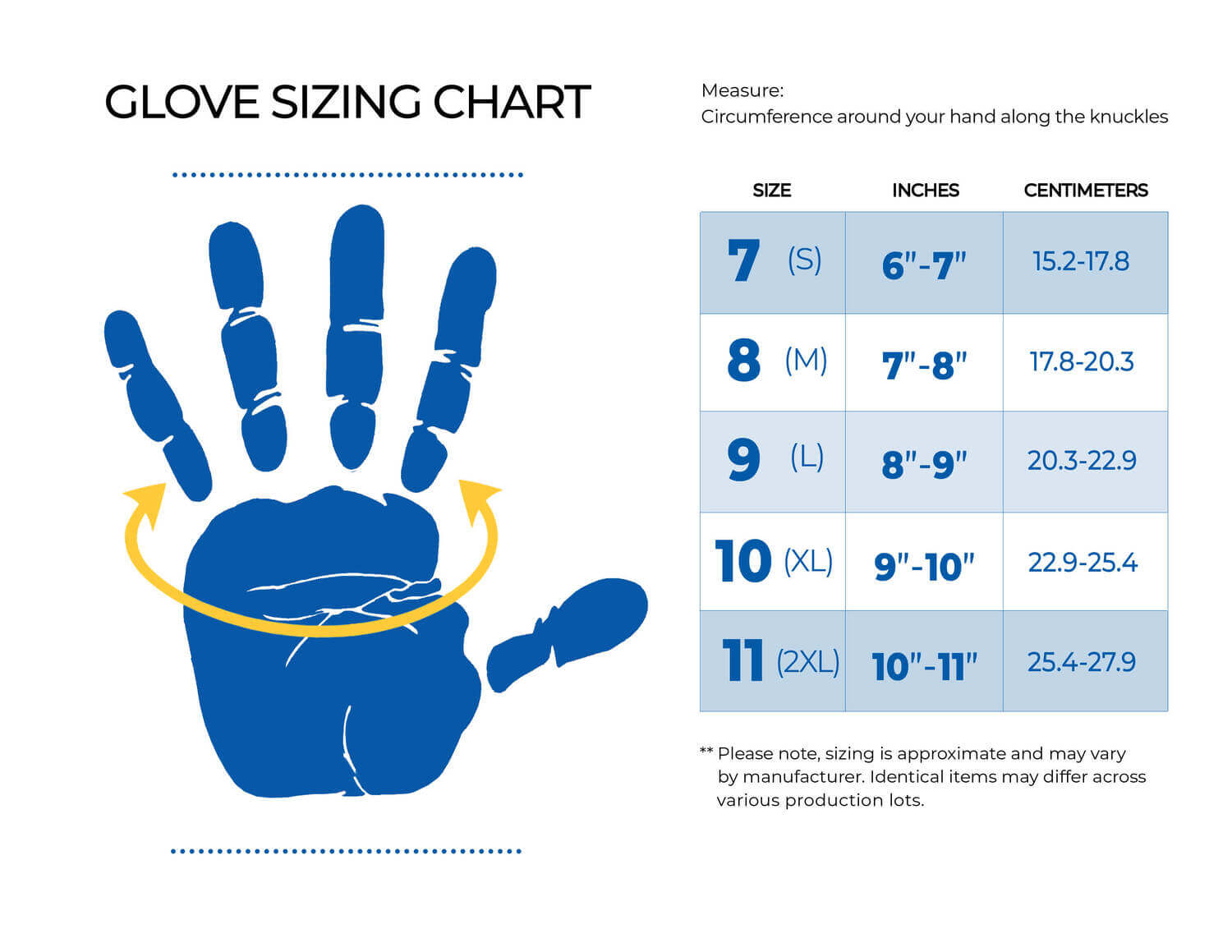
To find your correct size, wrap a fabric measuring tape or a strip of paper around your dominant hand at the widest point — across the knuckles, fingers together, thumb excluded — and note the circumference in centimetres.
| Hand circumference | Glove size |
|---|---|
| 17–18 cm | Size 7 (S) |
| 19–20 cm | Size 8 (M) |
| 21–22 cm | Size 9 (L) |
| 23–24 cm | Size 10 (XL) |
When between sizes, go larger — a slightly loose glove is more comfortable and safer than one that restricts movement. Size 7 (S) accommodates most smaller hands including many women’s hands; if your measurement is below 17 cm, check whether the manufacturer offers an XS option. Sizing can vary between manufacturers, so always check the specific size guide on the product page if available.
How to Wash and Care for Reusable Cleaning Gloves
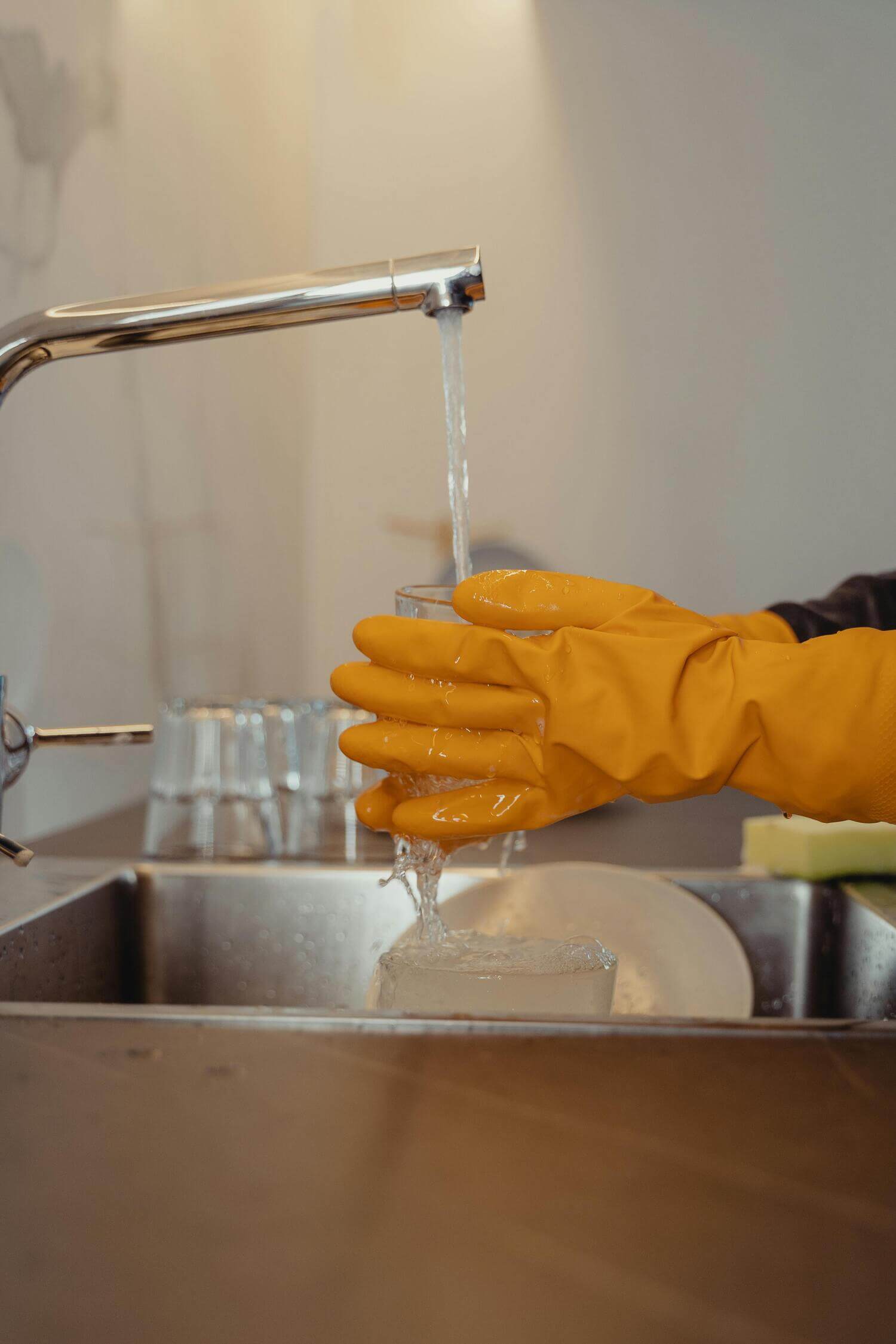
Reusable cleaning gloves can last weeks to months with straightforward care. The main causes of premature failure are chemical residue left on the material between uses, UV exposure during storage, and heat damage — all easily avoided. After each use:
- Rinse the outside of the gloves thoroughly with warm water while still wearing them. This removes the chemical residue responsible for most material degradation.
- Apply a small amount of mild soap, lather briefly, and rinse clean.
- Turn the gloves inside-out and rinse the interior to remove perspiration.
- Hang to dry at room temperature, away from direct sunlight and any heat source (radiators, boilers, and sunny windowsills all degrade latex and PVC over time).
- Once dry, turn right-side out and store in a cool, dry place.
Before each use:
- Hold the glove up to a light source and check for thin spots, discolouration, or small perforations. Run your fingers along the fingertips and palm — these wear first.
- Pinch the fingertips of latex gloves and check for loss of elasticity; latex that no longer springs back has begun to degrade.
- Any glove showing cracks, brittleness, colour changes, or holes should be replaced immediately.
What shortens glove life:
- Leaving chemical residue on the material between uses.
- Storing near a radiator or in direct sunlight.
- Using a glove beyond its chemical compatibility range (using a latex glove with solvent-based products, for example).
- Sharing gloves between users — which stretches and degrades the material faster and introduces a hygiene risk.
Condition is the right replacement guide, not calendar time. A glove used daily for heavy cleaning may need replacing after two to four weeks. A glove used twice a week for dishwashing can last several months. The moment the integrity of the material is in doubt, replace it.
Frequently Asked Questions
Can I use the same pair of gloves for all cleaning tasks?
No. Using one pair for toilet cleaning and then switching to dishwashing or food preparation transfers pathogens between environments. Keep at least two dedicated pairs — one for bathroom and toilet work, one for kitchen use — and never cross-use them on food contact surfaces. Professional cleaning environments follow a colour-coded system for this reason, outlined in the cross-contamination section above.
My hands feel itchy after wearing latex gloves. What is happening?
Either a Type I latex allergy or a Type IV accelerator reaction — and they need different solutions. If itching and redness appear within minutes of putting the gloves on, this is the pattern of a Type I immune response to latex proteins. Switch to latex-free PVC or nitrile and consult a doctor. If the reaction develops gradually over 12–48 hours after wearing, this is more likely Type IV contact dermatitis caused by accelerator chemicals (thiurams or carbamates) in the glove — and switching to standard nitrile will not help, since most nitrile gloves use the same accelerators. The correct solution is accelerator-free nitrile or a cotton-lined glove where the lining acts as a physical barrier.
Does CE Category III mean a glove is required for professional use?
No — CE Category III is determined by the severity of the chemical risk, not by whether you are a professional or home user. A commercial cleaner using mild surface sprays in an office may only need Category II. A home user descaling a boiler with concentrated acid needs Category III. Assess what you are handling, not who you are.
Are PVC gloves safe to use with food?
For kitchen cleaning and food-service work, yes — provided the gloves carry explicit food-contact certification and use phthalate-free plasticisers. For direct handling of high-fat foods (butter, raw meat, oils), latex or nitrile is more appropriate, as PVC can allow plasticiser migration into fatty materials. The SHOWA B0700R is food-contact certified and suitable for food-service cleaning and food handling in low-fat environments.
What is the difference between powdered and powder-free gloves?
Powder-free gloves are the correct choice for cleaning. Powdered gloves use corn starch or talc to ease donning, but the powder carries latex proteins into the air when gloves are snapped on, creating an inhalation risk for latex-sensitive individuals nearby. Powder also leaves residue on surfaces and hands, which is unsuitable for food environments. Powdered gloves are now banned for medical use in both the EU and the US. For cleaning purposes, always use powder-free.
How thick should cleaning gloves be?
For general household use, 0.30–0.45 mm offers the best balance of durability and tactile sensitivity. For professional cleaning with stronger chemicals, 0.40–0.60 mm is more appropriate. Above 0.80 mm, dexterity begins to suffer noticeably for most routine cleaning tasks.
How long do reusable cleaning gloves last?
With proper care, anywhere from a few weeks to several months depending on frequency and chemical exposure. Condition — not calendar time — is the right replacement indicator. Replace immediately if you see cracks, brittleness, colour changes, or any sign of perforation.
Can I wash cleaning gloves in the dishwasher or washing machine?
No — high-temperature machine washing rapidly degrades both latex and PVC. Hand rinse in warm water with mild soap after each use, as described in the care section above.
What is the difference between EN 374 Type A, B and C?
They describe how many chemicals the glove was tested against and at what protection level. Type C confirms splash resistance only, with no minimum breakthrough time requirement. Type B means testing against at least three standard chemicals with breakthrough times of 30 minutes or more. Type A requires testing against at least six chemicals at the same threshold — the highest EN 374 classification. For household and commercial cleaning, Type C is typically sufficient. For prolonged chemical exposure, look for Type B or A and check the specific chemical codes on the packaging against what you are using.
Ready to Choose?
For reliable reusable latex cleaning gloves with CE Category III certification, cotton flock lining, and a 30 cm cuff, the Coverguard Eurodip 5030 covers household and professional use.
For a latex-free alternative — whether due to allergy, precision requirements, or food-service use — the SHOWA B0700R is a CE-certified PVC glove with a second-skin fit that holds up to extended daily wear.
Browse our full range of protective cleaning gloves.
Gloves handle one half of the equation. The other is having the right cloth for the job — the wrong microfiber cloth leaves streaks, sheds fibres, or absorbs too little to be effective. Our guide to choosing the right microfiber cloth explains GSM, weave types, and which cloth works best for which surface.

Latest articles
Useful
How to Choose the Right Refillable Sprayer or Spray Can
A practical guide to choosing a refillable sprayer by mechanism, capacity, reach, nozzle, bottle fit and chemical compatibility, with a product selector.
Read moreUseful
How to Clean a Car Interior Safely: Plastic, Fabric, Leather, Screens and Glass
A practical material-by-material method for cleaning dashboards, displays, seats, carpets, glass and trim without excess moisture, harsh scrubbing or avoidable surface damage.
Read moreUseful
How to Choose a Mop for Your Floors and Cleaning Routine
A practical mop selection guide for hard floors, homes and offices. Compare manual and powered systems, moisture control, head width, pad fit and lifetime cost before buying.
Read moreUseful
How a Melamine Sponge Works, Where to Use It and What to Avoid
Melamine sponges can erase marks with water alone, but their fine abrasive action is not safe for every finish. Learn how they work, how to test a surface, what to[...]
Read moreNews
GoGoNano Affiliate Program is now open
GoGoNano's affiliate program is now open for responsible creators, customers, bloggers, publishers and partners who want to recommend practical surface-care products.
Read moreNews Product overviews
GoGoNano Business Accounts: B2B Pricing for Cleaning, Surface Care and Resale
GoGoNano B2B accounts help cleaning companies, car detailers, facility teams, offices, hotels, resellers and distributors access eligible business pricing, repeat ordering and product support.
Read moreUseful
How to Waterproof a Jacket: Restore DWR and Diagnose Leaks
Restore your jacket's water repellency at home: diagnose wetting out, clean and reproof the outer fabric, and avoid mistakes that damage seams, zips or membranes.
Read moreUseful
How to Wash Your Car at Home Without Scratching the Paint
Most car wash scratches come from rubbing loose dirt into the paint — not from washing itself. This guide covers the two-bucket method, the right microfiber tool for every surface,[...]
Read more