




How to Remove Limescale and Prevent It for Good — Room by Room
White crust on the faucet, cloudy film on the shower screen, a kettle that rattles when it boils. Limescale shows up wherever water touches a surface and dries there. Most advice stops at “use vinegar” — which works on some surfaces, damages others, and does nothing to stop the buildup from returning a week later. The right routine is sharper: identify the deposit, match the acid to the surface, remove the scale without damaging the finish, then stop water from drying there again.
Key takeaways
- Limescale is mineral buildup from hard water: it forms when water dries on a surface or is heated inside an appliance.
- Acid dissolves limescale, but the surface decides which acid is safe. What works in a kettle can damage chrome, grout, enamel, or natural stone.
- For ready-to-use household descalers, pH 2–4 is a useful range to look for on compatible acid-resistant surfaces. However, pH alone does not determine cleaning power or surface safety.
- Never mix descalers, vinegar, citric acid, or any acid with bleach or chlorine cleaners.
- Glass, faucets, tiles, toilets, coffee machines, washing machines, and natural stone all need different methods and contact times.
- Prevention mostly means removing water, cleaning deposits early, and using nano protection where it fits.
What limescale is and why it keeps coming back
Limescale is mostly calcium carbonate (CaCO₃) with some magnesium compounds mixed in. Tap water carries dissolved calcium and magnesium picked up from the ground it passed through — the more limestone in the bedrock, the harder the water. The USGS Water Science School defines water hardness exactly this way: dissolved calcium and magnesium in water.
While the minerals stay dissolved, they’re invisible. Two things push them out of solution and onto your surfaces:
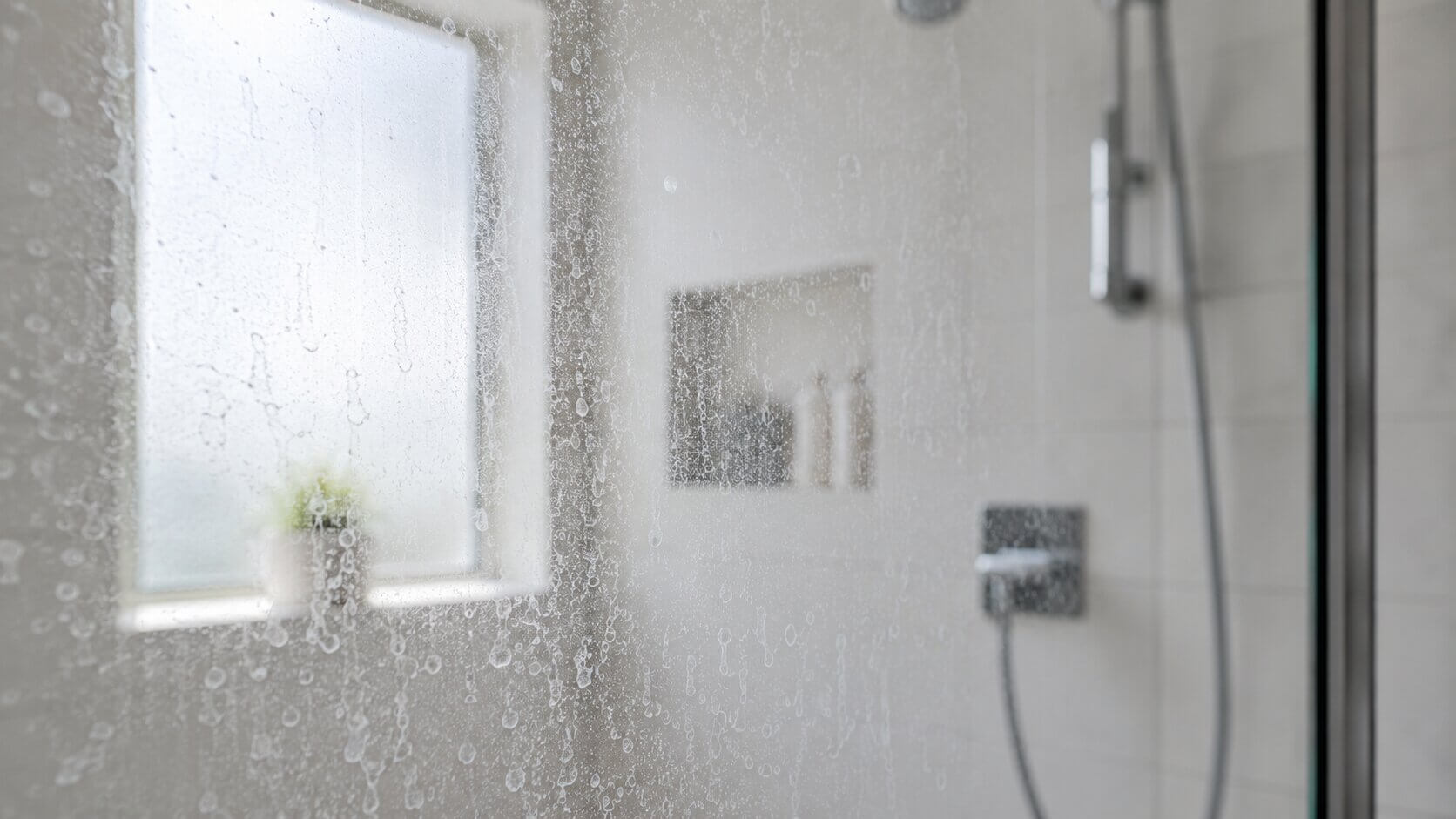
- Evaporation. When a water droplet dries on a faucet or shower wall, the water leaves but the minerals can’t. They crystallize exactly where the droplet sat — which is why limescale concentrates around taps, on shower glass, and along the waterline of the toilet bowl.
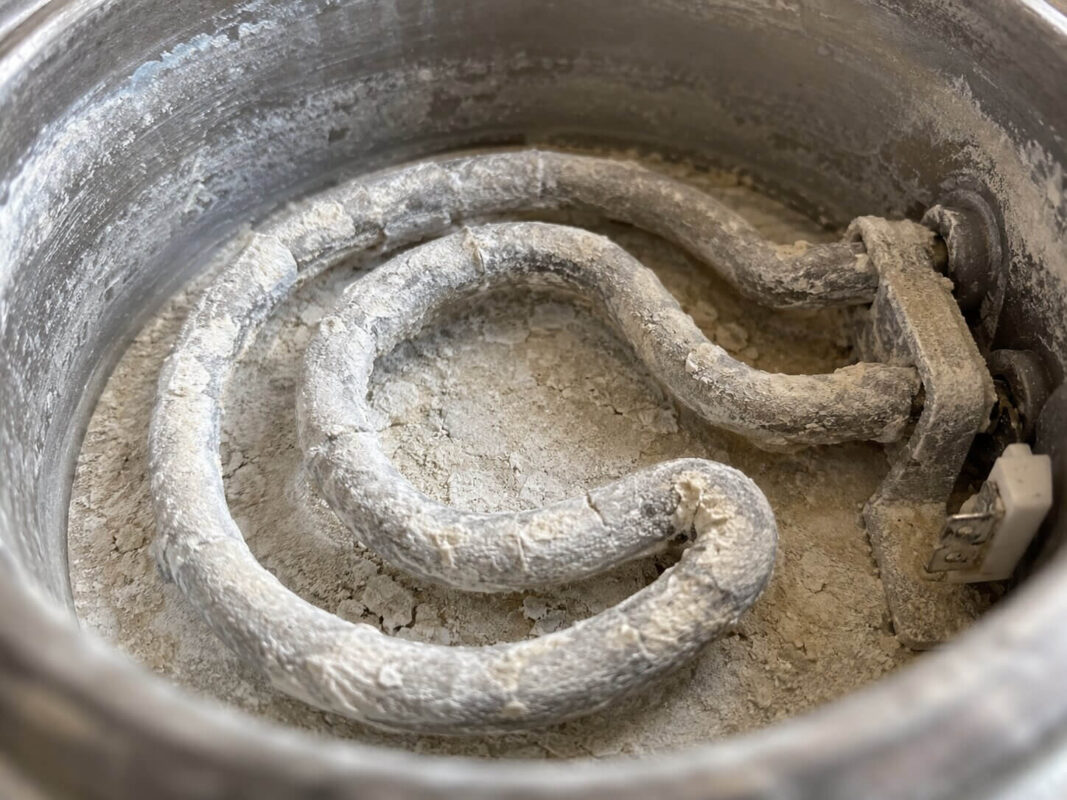
- Heat. Heating water drives off dissolved CO₂, which sharply reduces how much calcium the water can hold. The excess precipitates as scale directly onto the hottest surface available — the kettle bottom, the heating element of your washing machine, the boiler of your coffee machine.
Each new layer of scale is also rougher than the surface beneath it, so water clings to it more easily and the next layer forms faster. Buildup accelerates over time — which is why prevention matters more than any single cleaning session.
How hard is the water where you live?
Water hardness varies enormously across the Baltic and Nordic region. In Tallinn, water utility Tallinna Vesi reports drinking water hardness from about 1,8 mmol/l in summer and autumn up to 2,5 mmol/l in winter and spring — moderately hard to hard. Much of northern Estonia draws groundwater from limestone aquifers and gets noticeably harder water than the south. The same applies to large parts of Latvia and Lithuania. Finland sits at the other extreme: granite bedrock keeps most Finnish tap water soft, which is why limescale problems there concentrate in homes with private wells in coastal clay and limestone areas.
If your kettle develops visible scale within a few weeks, you live in a hard water area and prevention will save you real effort. If scale takes months to appear, occasional removal is enough.

Why limescale costs you money, not just looks
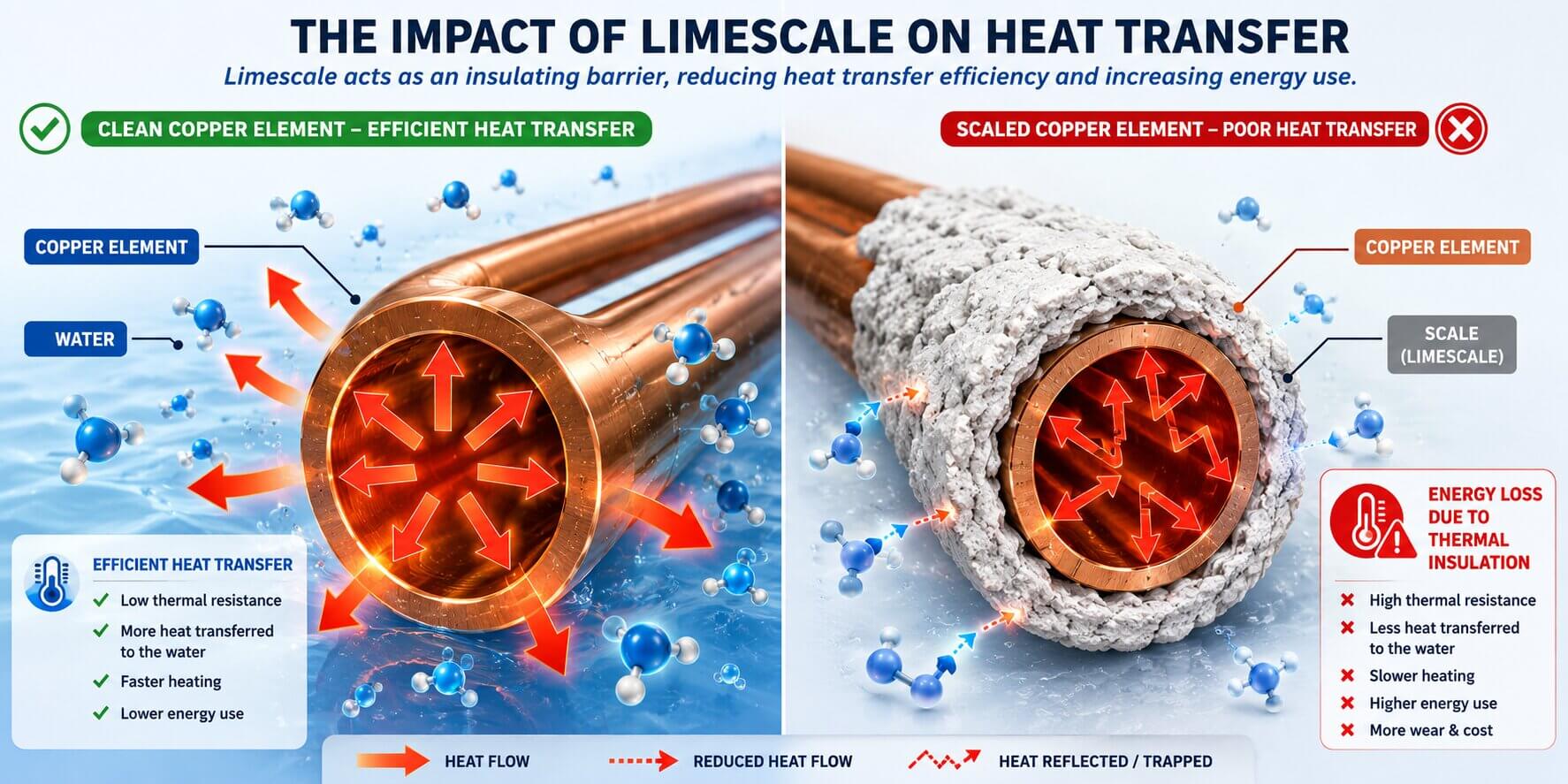
Calcium carbonate is a poor heat conductor — its thermal conductivity is roughly 2 W/(m·K), compared to about 400 for the copper in a heating element. A layer of scale on a heating element works like an insulating blanket the element must heat through before it heats the water.
The practical impact is well documented. The USGS notes that when hard water is heated, calcium carbonate scale can reduce equipment life, raise water-heating costs, lower electric water-heater efficiency, and clog pipes. Because water heating contributes to a building’s overall energy demand, preventing scale also supports the broader goal of improving building energy performance. A scale-covered water heater, washing machine, or kettle can quietly increase electricity use every day. Scale also stresses heating elements until they burn out, clogs spray arms and inlet valves, and blocks the narrow channels inside coffee machines.
Is it limescale, rust, or something else?
Before reaching for a descaler, it’s worth a ten-second check — the wrong diagnosis means the wrong cleaner:
- Limescale is white-to-grey, chalky, and slightly rough. It dissolves with a fizz when a drop of acid touches it. Found around taps, on glass, and anywhere water dries.
- Hard water stains are the early, thin version of the same thing — cloudy spots and films rather than crust. They wipe off with a normal cleaner if you catch them within days; left alone, they harden into scale.
- Rust and iron stains are orange-brown streaks, common under dripping taps and in homes with old pipes or iron-rich well water. Acid descalers barely touch them — they need a dedicated rust remover (typically oxalic-acid based), and bleach makes them worse by oxidizing the iron further.
- Cloudy drinking glasses can be either hard water film or glass corrosion. Rub a drop of vinegar on the glass: if the haze clears, it’s mineral film and a citric acid soak fixes it. If it stays, the dishwasher has etched the glass itself — permanent, and a sign to use a milder cycle, more rinse aid, or to wash delicate glasses by hand.
Limescale removal surface by surface
All limescale removal works the same way: an acid converts insoluble calcium carbonate into a soluble calcium salt that rinses away. The skill is matching the acid to the surface. A safe choice for a kettle can ruin a marble countertop, and a strong professional descaler can permanently dull chrome.
What pH should you look for in a limescale remover?
Because limescale is mainly alkaline calcium carbonate, most limescale removers are acidic — below pH 7. For a ready-to-use household descaler, a pH of about 2–4 is a useful starting range for compatible, acid-resistant surfaces. Products below pH 2 generally demand more caution and are often intended for acid-resistant toilet bowls or professional cleaning. Lower is not automatically better: the pH scale is logarithmic, so a product at pH 2 has ten times the hydrogen-ion activity of one at pH 3.
pH does not tell you how much limescale a product can remove. The acid type, total acid content, contact time, and complete formulation also matter. Two cleaners can have similar pH values but work very differently because one contains a larger acid reserve — meaning it can continue neutralizing more scale before its acidity is exhausted. Use pH as an indication of acidity, then check the label to confirm that the cleaner is suitable for the actual surface.
There is no acidic pH that is universally safe. Marble, limestone, and travertine can be etched even by a mildly acidic cleaner. Aluminum, damaged enamel, cement grout, and decorative tap finishes also need special care. On these materials, “less acidic” does not necessarily mean “safe.”
| Surface or item | Best first choice | Avoid | Prevention that matters |
|---|---|---|---|
| Chrome faucet / shower head | Mild citric or formic-acid descaler, short contact time | Strong toilet descalers, abrasive pads, long acid soaks | Wipe dry; renew a light nano layer during weekly cleaning |
| Faucet aerator | Unscrew, soak 30 minutes, brush the mesh | Forcing it with bare pliers and scratching the finish | Clean as soon as water flow sprays sideways |
| Shower glass | Dedicated glass-safe descaler, then glass coating | Letting deposits sit until they etch the glass | Squeegee after showers; protect with nano coating |
| Ceramic tile and grout | Mild descaler, short dwell time, thorough rinse | Strong acids on cement grout | Weekly cleaning before deposits crystallize |
| Kettle | Citric acid boil-and-soak | Vinegar if you dislike lingering smell | Use filtered water in hard water areas |
| Coffee machine | Manufacturer-approved descaler | Vinegar in machines with aluminum boilers or sensitive seals | Descale every 2–3 months in hard water areas |
| Natural stone | Plastic scraper plus pH-neutral cleaner | Vinegar, citric acid, formic acid, any descaler | Keep dry; seal stone where appropriate |
Faucets and shower heads
Chrome tolerates mild acids but not prolonged contact with strong ones. For a scaled shower head, unscrew it and soak it for 30–60 minutes in warm water with citric acid (about 1 tablespoon per litre), then scrub the nozzles with a soft brush and rinse. If the head can’t be removed, fill a plastic bag with the solution, secure it around the head with a rubber band, and let it work.
Don’t forget the faucet aerator — the small mesh insert at the tip of the tap. When water flow turns weak or sprays sideways, scale in the aerator is usually the culprit. Unscrew it by hand or with pliers over a cloth, soak the parts in the same citric acid solution for 30 minutes, brush, rinse, and screw back on.
For faucet bodies and the scale ring around the base, a ready-to-use descaler with a short contact time is safer than a prolonged acid soak. GoGoNano EcoDescaler uses a 0.4% formic-acid formula with a pH of 2.75. This places it in the acidic range needed to break down calcium-carbonate deposits without entering the extremely low-pH territory of some heavy-duty toilet and professional descalers. Spray it on, wait a few minutes, wipe, and rinse. It is still an acidic product, so follow the surface directions and keep it away from natural stone. EcoDescaler also leaves a thin nano coating behind that makes water sheet off instead of drying into new spots, which slows the next round of buildup for several weeks.
Shower glass
Glass deserves its own approach because mineral deposits can etch into the surface over time and become impossible to remove. We cover the full process — removal, the corrosion mechanism, and long-term protection with a dedicated glass coating — in our guide to nano coating for glass.
Tiles and grout
Glazed ceramic tiles handle most descalers well. Grout is the weak point: cement-based grout contains calcium compounds itself, so strong acids eat the grout along with the scale. Use a mild descaler, keep contact time short, and rinse thoroughly. For routine maintenance between descaling sessions, a neutral cleaner is enough to remove fresh deposits before they harden.
Kettle
- Fill the kettle halfway with water and add 1–2 tablespoons of citric acid.
- Boil, then let it stand for 30 minutes.
- Pour out, rinse twice, and boil one batch of clean water to discard.
Citric acid is odorless and food-safe, which makes it better suited to kettles than vinegar — no lingering smell in your next cup of tea.
Coffee machine
Espresso machines and capsule machines scale up internally where you can’t see it, and a blocked thermoblock is one of the most common reasons they fail. Follow the manufacturer’s descaling cycle and interval — typically every 2–3 months in hard water areas. Use citric-acid-based or manufacturer-approved descaler; vinegar can damage internal seals and aluminum boilers.
Toilet
The brown or grey ring at the waterline is limescale that has absorbed iron and dirt, not a stain that bleach can fix — chlorine has no effect on mineral deposits. Lower the water level by pushing water past the bend with the brush, apply descaler directly to the ring, let it work 15–30 minutes, then scrub. Repeat for thick, old deposits rather than reaching for aggressive acids that damage the glaze.
Washing machine and dishwasher
These two hide the most expensive scale in the house because it forms on the heating element where you never see it. A simple maintenance routine keeps it under control:
- Run the washing machine empty on its hottest cycle with 6–8 tablespoons of citric acid in the drum every 2–3 months in hard water areas.
- For the dishwasher, run an empty hot cycle with citric acid in the detergent compartment on the same schedule.
- Wipe rubber door seals afterwards and leave doors open to dry — this also prevents mold.
- Check and rinse the dishwasher spray arm nozzles if you notice cloudy glasses or poor washing results.
What NOT to use where
Most limescale damage is done by the cleaner, not the scale. These combinations cause permanent harm:
- Never mix a descaler or any acid with bleach or chlorine cleaners. The reaction releases chlorine gas, which is dangerous in an enclosed bathroom. Poison Control is explicit on this: bleach plus acid forms chlorine gas. Use one product at a time and rinse thoroughly before switching — including in the toilet bowl, where bleach residue often lingers.
- Strong descalers on delicate tap finishes. Matte black, brushed brass, gold-toned, and PVD- or lacquer-coated taps are far more sensitive than standard chrome — acids and abrasive pads dull or strip the finish permanently. Use a pH-neutral or very mild cleaner, keep contact times short, test a hidden spot first, and rely on wiping dry rather than chemistry.
- Vinegar or any acid on natural stone. Marble, limestone, and travertine are calcium carbonate — chemically the same material as limescale. Acid dissolves the stone surface itself, leaving dull etch marks that only professional polishing can remove. On natural stone, scale must be removed mechanically with a plastic scraper and pH-neutral cleaner.
- Very low-pH descalers on chrome. Heavy-duty toilet and drain cleaners — especially hydrochloric-acid formulas — can strip the chromium layer, leaving permanently matte or pitted metal. Low pH is an important warning, but smell is not a reliable safety test. Check the product label, use only cleaners approved for chrome, and keep the contact time short.
- Vinegar on rubber seals and gaskets. Repeated acetic acid exposure hardens and cracks the rubber in washing machine doors, dishwasher seals, and faucet O-rings. Citric and formic acid are gentler choices.
- Acid on enamel damage. Worn or chipped enamel on old bathtubs absorbs acid and stains. Test in a hidden spot first.
- Descalers on aluminum espresso parts unless the label explicitly allows it — some acids corrode aluminum boilers.
Prevention: stop limescale before it forms
Limescale needs one thing to form: water drying on a surface. Every prevention method attacks that single requirement, and combined they reduce descaling from a monthly battle to an occasional touch-up.
Remove the water. A squeegee pass over shower walls takes 20 seconds and removes the water before it can evaporate. Wiping the faucet dry after the evening routine does the same. Twenty seconds a day, and most visible bathroom scale never gets the chance to form.
Clean before deposits harden. Fresh limescale is soft and wipes away with a regular cleaner; after a few weeks it crystallizes and needs acid. Weekly cleaning with EcoClean keeps deposits at the soft stage so they never get the chance to build.
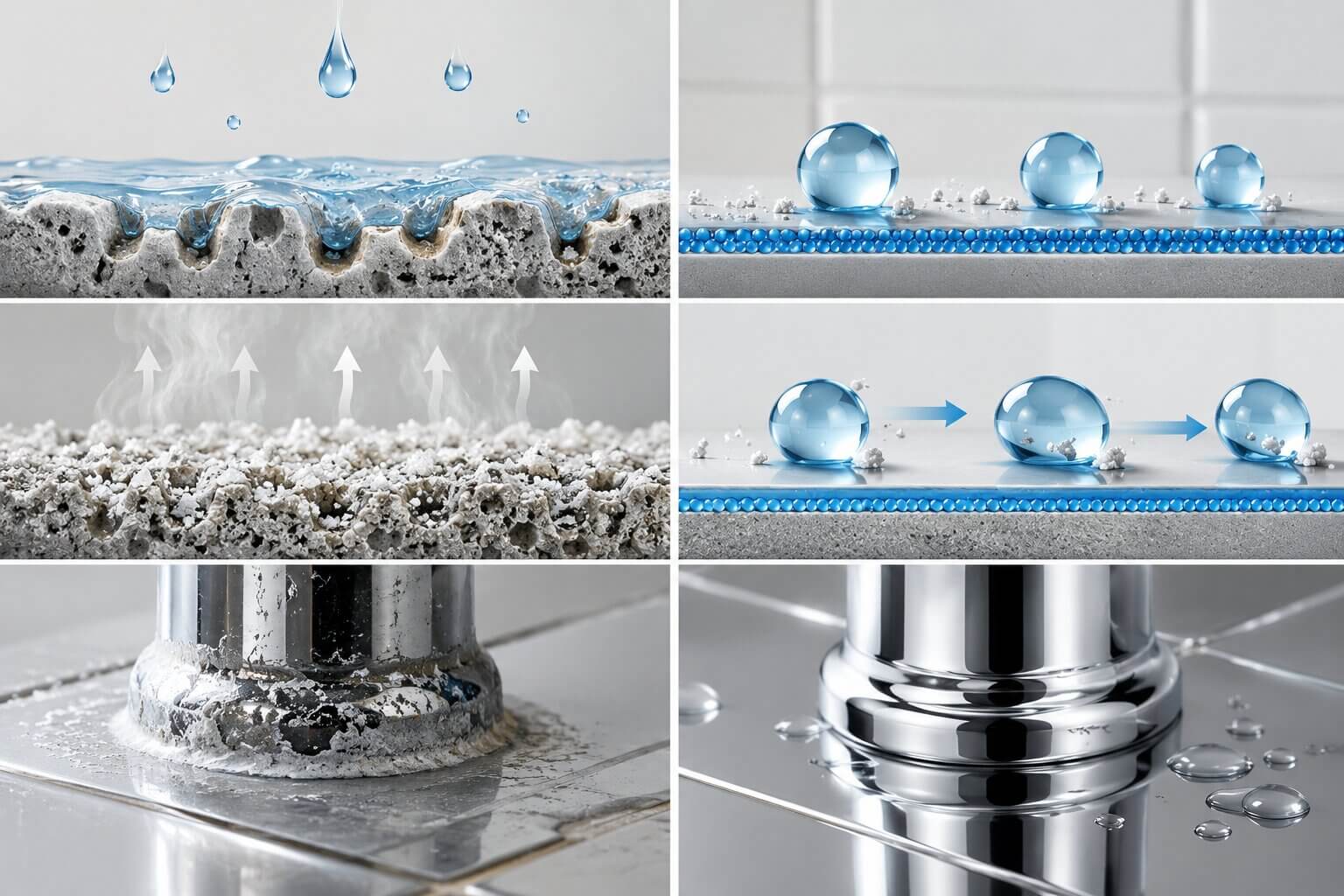
Make the surface harder to stick to. Here’s where nanotechnology changes the routine. A nano coating fills the microscopic pores and ridges that water clings to, so droplets bead up and roll off carrying their minerals with them — instead of flattening out, evaporating, and leaving the minerals behind. With less water drying on the surface, less scale forms. The 2-in-1 formulas (EcoClean, EcoDescaler) renew a light protective layer with every cleaning that lasts 2–4 weeks, while a dedicated coating such as EcoCare is the longer-lasting option for non-glass bathroom and kitchen surfaces: tiles, ceramics, chrome, metal, plastic, sinks, faucets, and shower fittings. Keep EcoGlass for shower glass, where the coating needs to suit glass specifically. Floors are usually less of a limescale problem; EcoFloor, as a floor cleaner with nano protection, belongs more to wet-room floor maintenance than to the descaling step.
Soften the water itself. A whole-house ion-exchange softener removes calcium before the water reaches your taps and is the only method that protects hidden surfaces — pipes, boiler, washing machine element — as well as visible ones. It’s also the most expensive option: installation, salt refills, and maintenance only pay off in genuinely hard water areas. A cheaper targeted version of the same idea is to fill the kettle and coffee machine from a filter jug, which removes much of the temporary hardness exactly where scale costs you the most. Magnetic and electronic “descaler” gadgets, by contrast, have no consistent independent evidence behind them.
In very hard water areas, the full system looks like this: descale once to get back to a clean surface, apply protection, then maintain with quick weekly cleaning. The scale that used to need scrubbing now rinses off.
Frequently asked questions
What is the difference between hard and soft water?
Hard water contains high levels of dissolved calcium and magnesium, picked up from limestone and chalk bedrock. Soft water contains little of either, which is typical of granite regions and surface water sources. Hard water causes limescale and reduces soap lathering, but it is completely safe to drink — the minerals are the same ones found in mineral water.
Does boiling water remove hardness?
Partly, but it doesn’t help your appliances. Boiling removes temporary hardness by forcing the calcium out of solution — which is exactly how scale forms in your kettle. The minerals don’t disappear; they move from the water onto the heating surface. Permanent hardness (calcium sulfate) survives boiling entirely.
How often should I descale my appliances?
In hard water areas: kettle every 4–6 weeks, coffee machine every 2–3 months, washing machine and dishwasher every 2–3 months with an empty hot cycle. In soft water areas, two to four times a year is enough. The kettle is your indicator — when you see scale there, the hidden heating elements in other appliances have it too.
What pH is best for a limescale remover?
For a ready-to-use household descaler, approximately pH 2–4 is a useful range for compatible, acid-resistant surfaces. A product below pH 2 usually requires greater caution. However, pH is not a surface-safety or performance rating: acid type, total acid content, contact time, and the material being cleaned matter just as much. GoGoNano EcoDescaler has a pH of 2.75. Never use an acidic descaler on marble, limestone, travertine, or another acid-sensitive surface.
Can limescale damage my health?
No. Calcium and magnesium in drinking water are harmless and contribute slightly to daily mineral intake. The USGS notes that hardness itself is not a health concern, even though it is a serious nuisance for plumbing, fixtures, and heaters. The flakes that come loose from a scaled kettle are unappetizing but not dangerous. The damage limescale does is to appliances, energy bills, and surfaces — not to people.
Is a water softener worth the money?
In genuinely hard water areas (roughly 2,5 mmol/l and above), often yes — it’s the only solution that also protects pipes and hidden heating elements, and it pays back through lower energy use and longer appliance life. In moderately hard areas, a filter jug for the kettle and coffee machine plus surface protection achieves most of the benefit for a fraction of the cost.
Why does limescale come back so fast after cleaning?
Cleaning removes the deposit but leaves the surface microscopically rough, especially after scrubbing — and rough surfaces hold water droplets longer, so new scale forms faster than on a smooth surface. Breaking the cycle requires either keeping the surface dry (squeegee, wiping) or applying a protective coating that makes water roll off before it evaporates.

Latest articles
Useful
How to Choose the Right Refillable Sprayer or Spray Can
A practical guide to choosing a refillable sprayer by mechanism, capacity, reach, nozzle, bottle fit and chemical compatibility, with a product selector.
Read moreUseful
How to Clean a Car Interior Safely: Plastic, Fabric, Leather, Screens and Glass
A practical material-by-material method for cleaning dashboards, displays, seats, carpets, glass and trim without excess moisture, harsh scrubbing or avoidable surface damage.
Read moreUseful
How to Choose a Mop for Your Floors and Cleaning Routine
A practical mop selection guide for hard floors, homes and offices. Compare manual and powered systems, moisture control, head width, pad fit and lifetime cost before buying.
Read moreUseful
How a Melamine Sponge Works, Where to Use It and What to Avoid
Melamine sponges can erase marks with water alone, but their fine abrasive action is not safe for every finish. Learn how they work, how to test a surface, what to[...]
Read moreNews
GoGoNano Affiliate Program is now open
GoGoNano's affiliate program is now open for responsible creators, customers, bloggers, publishers and partners who want to recommend practical surface-care products.
Read moreNews Product overviews
GoGoNano Business Accounts: B2B Pricing for Cleaning, Surface Care and Resale
GoGoNano B2B accounts help cleaning companies, car detailers, facility teams, offices, hotels, resellers and distributors access eligible business pricing, repeat ordering and product support.
Read moreUseful
How to Waterproof a Jacket: Restore DWR and Diagnose Leaks
Restore your jacket's water repellency at home: diagnose wetting out, clean and reproof the outer fabric, and avoid mistakes that damage seams, zips or membranes.
Read moreUseful
How to Wash Your Car at Home Without Scratching the Paint
Most car wash scratches come from rubbing loose dirt into the paint — not from washing itself. This guide covers the two-bucket method, the right microfiber tool for every surface,[...]
Read more