




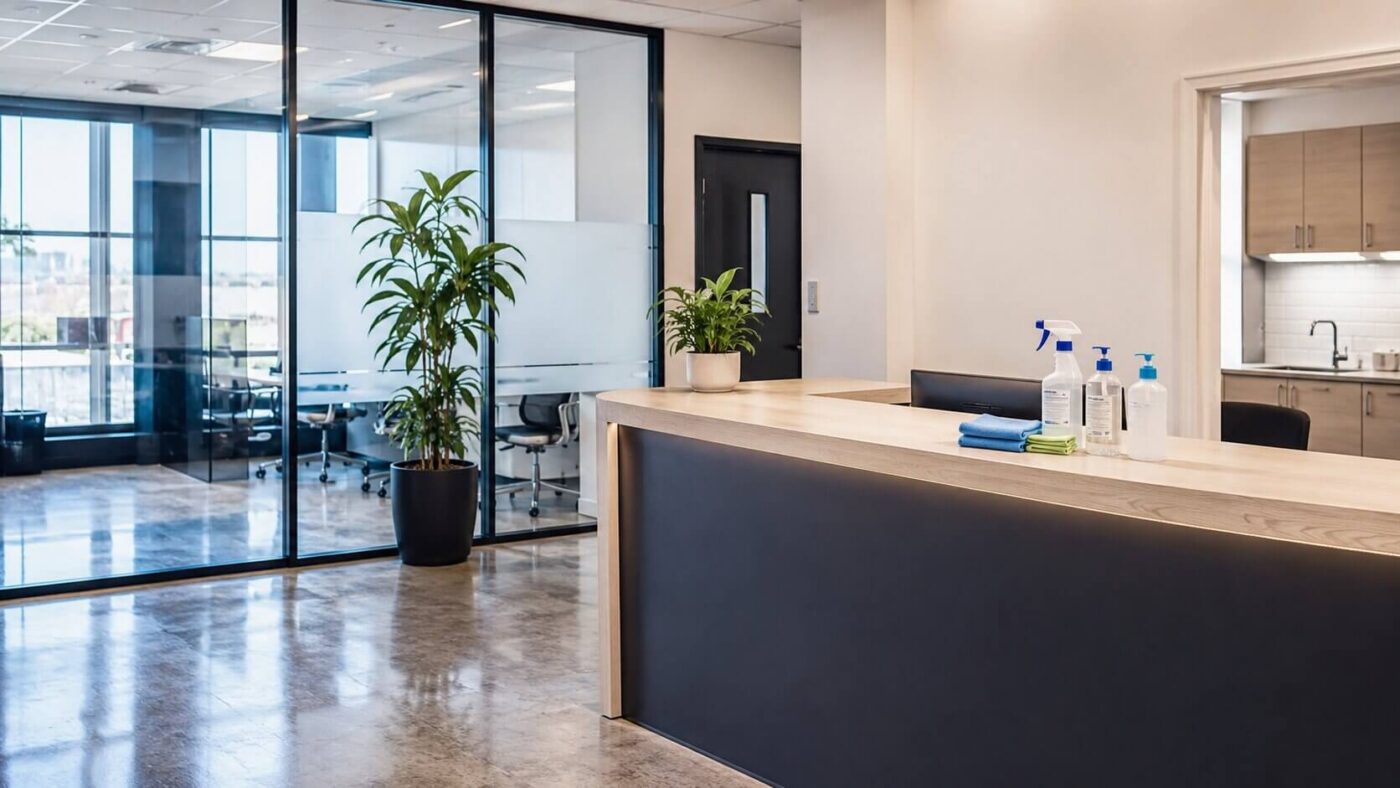
Office Cleaning for Small Businesses: How to Keep Workspaces Cleaner for Longer
Quick answer
The best office cleaning routine for a small business is surface-based: clean high-touch areas daily, keep glass and bathrooms ahead of visible buildup, protect problem surfaces so dirt grips less, and disinfect only when needed. This keeps workspaces presentable with fewer repeat wipe-downs and fewer unnecessary products.
Office cleaning for small businesses is usually treated as background work: someone wipes the desk, someone mops the floor, someone notices the glass door only after fingerprints are already obvious. The problem is not that small teams do not care about cleanliness. The problem is that most cleaning routines only reset the surface for a short time, then the same dirt, water marks, dust, and fingerprints return almost immediately.
A better routine starts with a different question. Instead of asking how often the office needs to be cleaned, ask which surfaces keep creating work. Reception counters, door handles, shared desks, bathroom tiles, glass partitions, windows, mirrors, kitchen surfaces, and floors all behave differently. When each surface is cleaned and protected in the right way, the space stays presentable for longer and the next clean takes less effort.
Key takeaways
- Small business cleaning should be built around surfaces, not just rooms. A desk, glass door, bathroom tile, and hard floor do not collect dirt in the same way.
- High-touch surfaces need a daily routine. Door handles, switches, counters, shared keyboards, taps, and kitchen touchpoints should not wait for a weekly deep clean.
- Cleaning, sanitizing, and disinfecting are different jobs. Routine cleaning removes dirt and many germs; disinfecting is for higher-risk situations and must follow the product label and contact time.
- Surface protection reduces repeat work. Nano protection helps dirt, water, fingerprints, and mineral deposits attach less strongly, so maintenance cleaning becomes faster.
- GoGoNano’s home series also fits business spaces. Offices, salons, clinics, studios, retail counters, and shared workspaces have the same glass, sanitary, hard-surface, and floor problems as homes, only with more daily traffic.
Why cleanliness matters more in a small business
In a large company, cleaning may be hidden inside a facilities contract. In a small business, it is often much more visible. The owner, office manager, assistant, receptionist, or team member notices when supplies run out, when a bathroom starts looking tired, when the meeting-room glass is covered in fingerprints, or when the entrance floor looks dull after wet weather.
That visibility matters because a small workspace often has several jobs at once. It is a place where employees focus, customers form an impression, partners visit, parcels are packed, consultations happen, and shared equipment is used by several people in the same day.
A clean workspace is easier to work in. It reduces the small visual irritations people learn to ignore until they have to sit in them all day: fingerprints on meeting-room glass, dusty desk edges, a dull entrance floor, or a bathroom that technically functions but does not feel cared for. A study on office environments found that higher measured cleanliness correlated with higher perceived productivity and work satisfaction among office employees. You can read the study abstract through Wageningen University & Research.
Cleanliness also supports hygiene where it matters most. The CDC recommends cleaning high-touch surfaces regularly and cleaning other surfaces when visibly dirty. For a small business, that means daily attention to the surfaces many hands touch: handles, switches, taps, card terminals, shared desks, coffee machines, and bathroom touchpoints.
Then there is the trust signal. A customer may not notice every clean surface, but they notice neglect quickly. Clear glass, a fresh bathroom, a clean counter, and a well-kept floor tell visitors that the business pays attention before anyone has said a word.
The point is not to turn every business owner into a full-time cleaner. The point is to make cleanliness easier to maintain, because small teams have better things to do than fix the same dirty surface again and again.
Traditional cleaning often works only until the surface is used again. A cleaner removes the visible dirt, but the material underneath remains exposed. A glass door accepts new fingerprints. A bathroom tap collects mineral deposits. A tile wall grabs soap residue. A hard floor picks up shoe marks. A desk surface holds skin oils, dust, and coffee rings.
For a small business, the cost is rarely one dramatic expense. It is a steady leak of time and materials. A glass door that needs several quick wipe-downs a day, a bathroom tap that needs scrubbing every week, or a floor that looks dull by lunchtime may not feel like a budget problem at first. But even 10 minutes of avoidable repeat cleaning each workday becomes more than 40 hours a year.
There is also the supply problem. The more single-purpose bottles a business keeps for glass, bathroom, kitchen, floors, limescale, disinfection, and general surfaces, the easier it becomes to overbuy, run out of the one product people actually need, or use the wrong cleaner on the wrong material. Stronger chemicals and heavier scrubbing can also shorten the life of surfaces that should have lasted longer.
This is a supply-cost issue as much as a cleaning issue. A centralized, surface-specific kit reduces duplicate purchases, cuts down on half-used single-purpose chemicals, and makes reordering more predictable.
When a surface is protected after cleaning, the routine changes. Dirt still exists. People still touch doors. Shoes still bring in dust and moisture. But grime has less grip, so normal maintenance becomes lighter, faster, and more predictable.
Cleaning, sanitizing, and disinfecting are not the same thing
This distinction matters in workplaces because it keeps the cleaning routine honest. Not every dirty surface needs disinfectant. Not every disinfected surface is visually clean. And no product can perform properly if the instructions are ignored.
Cleaning removes dirt, dust, oils, and many germs from the surface. For most ordinary office maintenance, regular cleaning with the right product and cloth is the foundation.
Sanitizing reduces the remaining germs on a cleaned surface. It is usually relevant in hygiene-sensitive contexts, food-related areas, and specific product categories where sanitizing claims are supported.
Disinfecting kills harmful germs that remain after cleaning. It is useful when someone has been ill, during outbreaks, or in shared areas where a higher hygiene level is needed. Disinfectants require the correct product, correct surface, enough liquid, and the full labelled wet contact time.
For everyday office cleaning, the practical sequence is simple: clean first, protect where protection makes sense, and disinfect when the situation calls for it. GoGoNano’s 2-in-1 cleaning and protection products are designed for routine surface care. When disinfection is needed, use a dedicated disinfectant and follow the label.
We cover disinfectant choice, contact time, material compatibility, and certification in much more detail in our article on how to safely disinfect surfaces from viruses. For this office-cleaning article, the important point is simpler: do not use disinfectant as a substitute for a proper cleaning system.
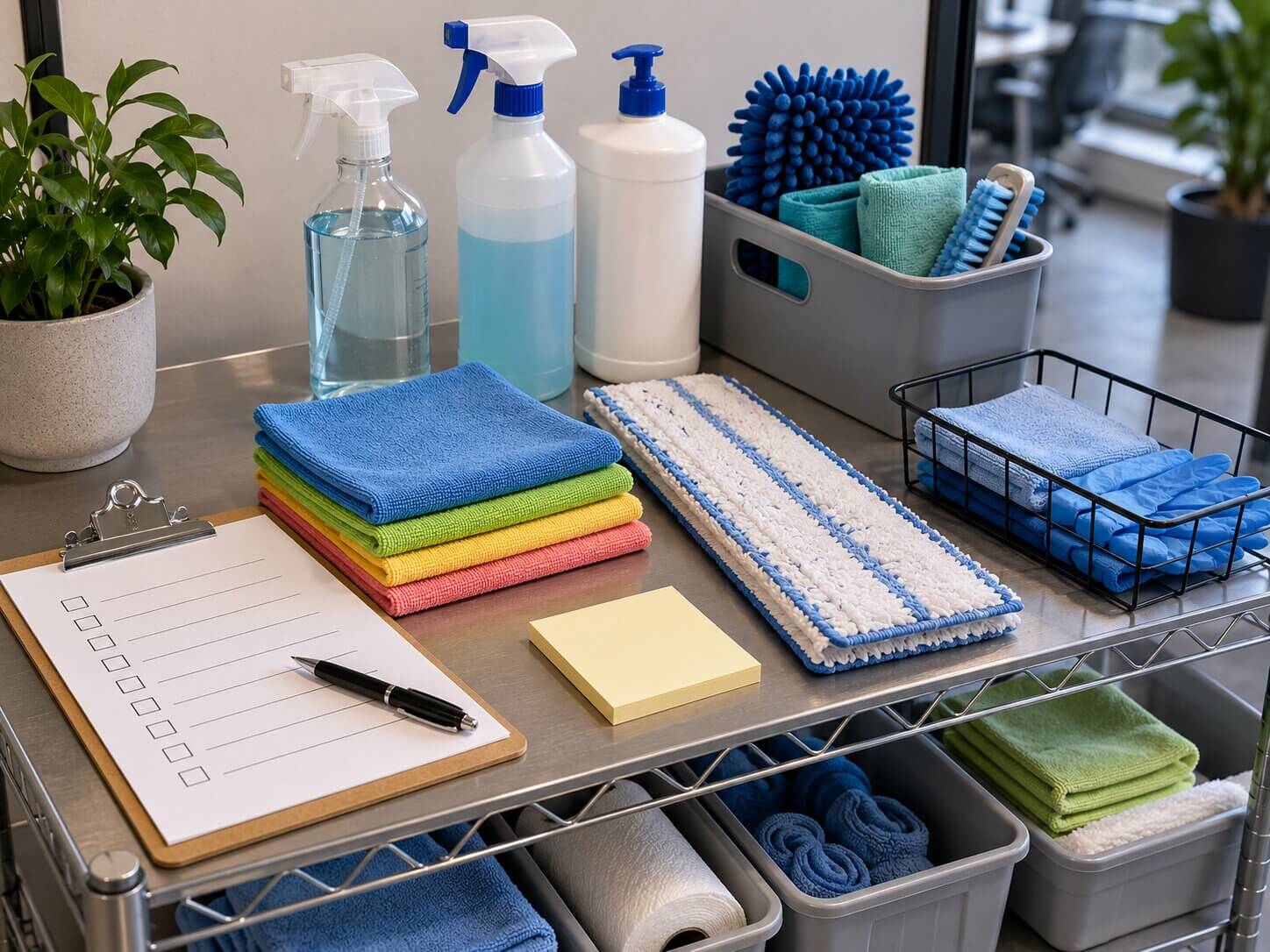
A practical office cleaning checklist for small businesses
A checklist should be short enough that people actually use it. The easiest way to build one is by frequency: daily, weekly, monthly, and quarterly. Then adjust it based on traffic, season, and the type of business.
Daily office cleaning tasks
- Reception and customer areas: wipe counters, card terminals, door handles, display surfaces, waiting-room tables, and visible glass marks.
- Workstations: wipe shared desks, chair arms, desk phones, keyboards, mice, and touchscreens where several people use the same equipment.
- Kitchen or break area: clean counters, taps, sink area, appliance handles, coffee machine buttons, microwave handle, fridge handle, and table surfaces.
- Bathrooms: clean taps, sink, toilet flush, door handles, light switches, dispensers, splash-prone tiles, and visible marks on mirrors.
- Floors: remove visible dirt from entrances, corridors, customer zones, and kitchen/bathroom areas.
Weekly office cleaning tasks
- clean glass doors, partitions, mirrors, and interior windows more thoroughly;
- wipe shelves, cabinets, meeting-room tables, chair backs, handles, and storage areas;
- mop hard floors with a product suitable for the floor type;
- clean bathroom tiles, sanitary surfaces, and limescale-prone fittings before buildup becomes stubborn;
- wash or replace used microfiber cloths according to color or area system.
Monthly office cleaning tasks
- check high shelves, vents, skirting boards, window frames, and corners where dust collects;
- review entrance floors, chair bases, and high-traffic areas for marks or dullness;
- inspect bathrooms for limescale, soap residue, tile staining, and grout discoloration;
- review the cleaning supply cupboard and reorder before products run out;
- refresh protective treatments on problem surfaces according to product instructions.
Quarterly office cleaning tasks
- deep-clean glass, exterior-facing windows, display glass, and partitions that are not part of the weekly routine;
- remove heavier limescale in bathrooms, kitchens, staff showers, or other wet areas before it hardens into a long-term surface problem;
- review hard floors for traffic lanes, dull patches, worn entrance areas, and surfaces that may need professional maintenance;
- check dedicated nano coatings such as EcoCare and EcoGlass Protector on high-use surfaces, and reapply if protection has worn, typically every three to six months depending on traffic and product instructions;
- check ventilation grilles, high dust areas, storage rooms, and areas behind furniture or appliances;
- review the written cleaning routine and product stock list so new staff or contractors can follow the same system.
For a small business, this checklist is not meant to add work. It helps remove guesswork. When everyone knows which surfaces matter most, cleaning stops becoming a vague “someone should do this” task.
Most cleaning complaints come from a few repeat surfaces
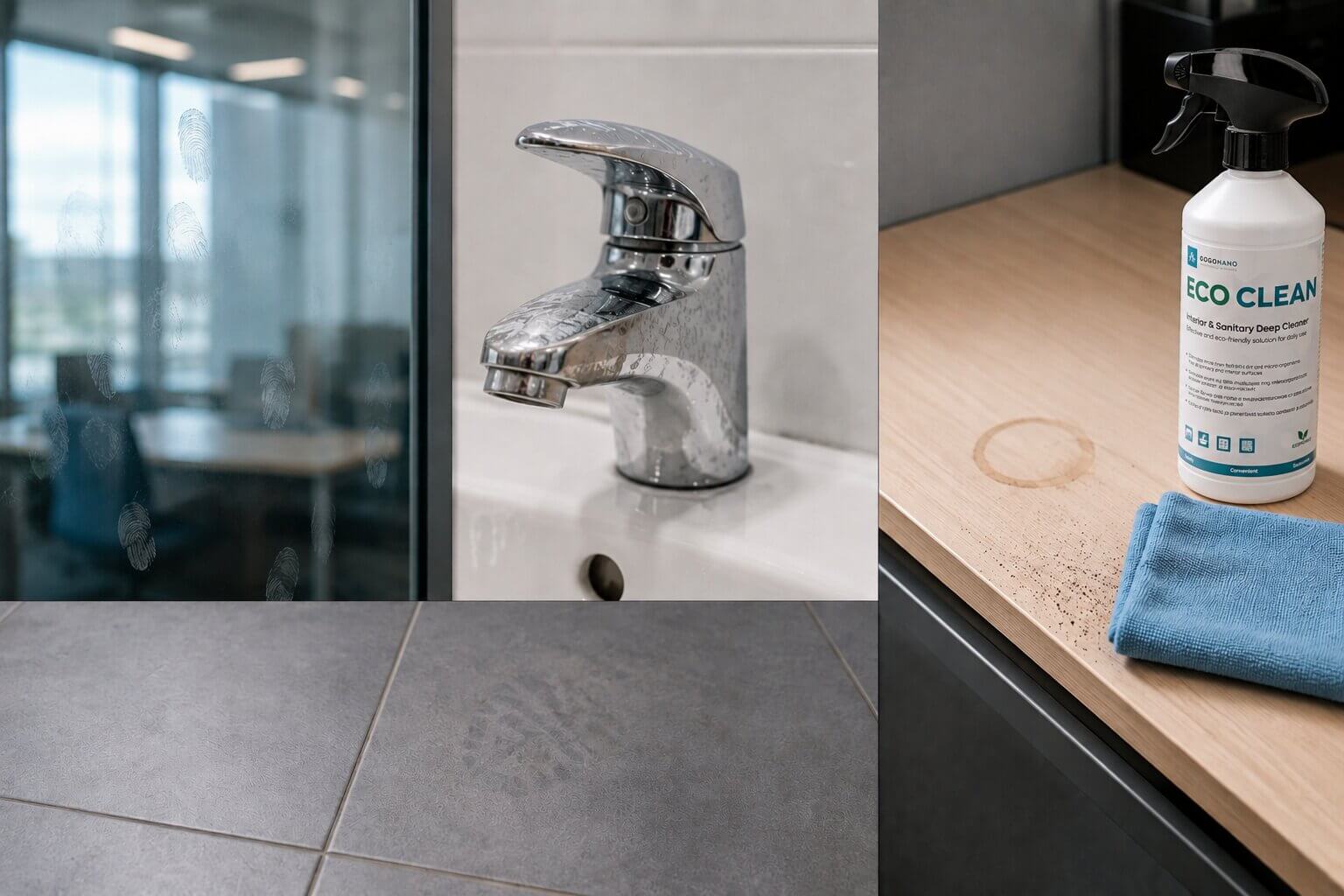
In small workplaces, the same areas usually create the same complaints: glass that looks marked, bathrooms that look tired, entrance floors that lose their clean finish, and shared counters that never stay fresh for long. These are not random failures in the routine. They are surfaces where dirt has an easy place to grip.
Glass doors and partitions show fingerprints quickly because office lighting catches every smear. Bathroom taps, tiles, sinks, and staff shower areas collect minerals and soap residue after repeated use.
Floors near entrances collect moisture, grit, and shoe marks faster than quiet areas. Kitchen surfaces and reception counters carry a daily mix of coffee, water spots, packaging residue, appliance handles, card terminals, and hand oils.
If one of these surfaces looks dirty again shortly after cleaning, cleaning more often may help, but it is not the whole answer. The better question is why that surface is holding onto marks so easily.
What INSTA 800 teaches small businesses about visual cleaning quality
In Nordic and Baltic cleaning procurement, INSTA 800 is often used as a common way to define and assess cleaning quality. Its value for a small business is not that every office needs a formal inspection system, but that it changes the question: which visible conditions make the space fail the eye test?
INSTA 800 is result-oriented. It looks at achieved cleanliness on defined object groups and areas, using visual inspection and, where needed, measurement methods. In plain office terms, visible dirt, dust, stains, fingerprints, water marks, and other surface defects matter because they shape whether the space feels maintained.
Surface protection does not replace cleaning staff, a checklist, or a formal quality standard. But when glass, sanitary surfaces, counters, or floors are treated so water, fingerprints, limescale, and grime attach less strongly, the office has a better chance of staying within a high visual cleanliness expectation between scheduled cleans.
For a small team, the practical takeaway is simple: think like a quality inspector. Identify the surfaces that visually fail first, then clean and protect those surfaces before they become the reason the whole workspace feels neglected.
Clean and protect: the better maintenance logic
GoGoNano’s home series is built around a simple idea: the product should do more than remove today’s dirt. Where the surface allows it, the product should also help make tomorrow’s dirt easier to remove.
That is why the same product logic works in business spaces. A small office has the same desks, glass, tiles, floors, taps, sinks, doors, and mirrors as a home. The difference is traffic. More people touch the same surfaces, so the benefit of easier maintenance becomes even more visible.
A clean-and-protect routine starts by removing what is already there: dirt, grease, dust, limescale, or old residue. Then the right protective product is used for the material. Glass, sanitary surfaces, hard floors, and general hard surfaces do not need the same formula. Once the surface has less grip, routine wiping or mopping becomes faster and usually needs less aggressive effort.
This does not make a surface maintenance-free; it simply reduces how strongly everyday dirt attaches, so the next clean usually takes less effort.
Which GoGoNano product fits each office surface?
The table below compares the usual “clean it again” routine with a surface-specific clean-and-protect approach. Use it as a starting point for building a small business cleaning kit.
| Office surface or problem | What standard cleaning usually does | Clean-and-protect route | GoGoNano fit | Important note |
|---|---|---|---|---|
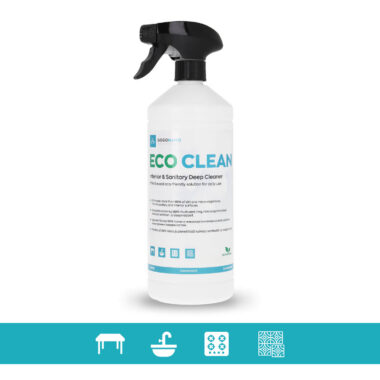
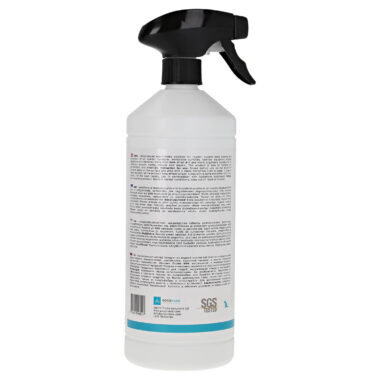
| Desks, counters, handles, shelves, kitchen surfaces | Removes visible dirt, but fingerprints, oils, and dust return quickly. | Use an all-purpose cleaner that also leaves the surface easier to maintain. | EcoClean for ceramic, chrome, enamel, stainless steel, acrylic, sealed wood, plastic, and most hard office surfaces. | Do not use EcoClean on glass. Use the dedicated glass system for windows, mirrors, and glass doors. |
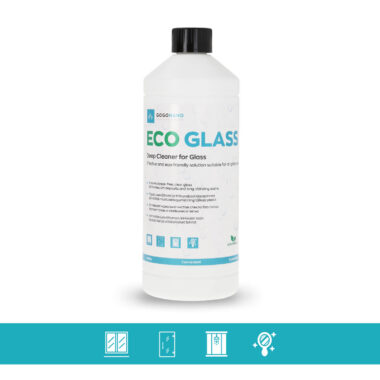
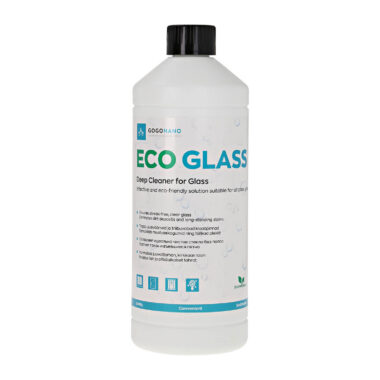
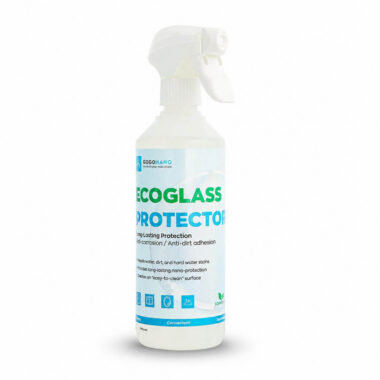
| Windows, mirrors, glass doors, meeting-room partitions | Cleans marks for the moment, but smears and fingerprints show again under light. | Clean glass first, then protect clean and dry glass so water, fingerprints, and dirt attach less strongly. | EcoGlass for streak-free cleaning, followed by EcoGlass Protector for longer-lasting glass protection. | Apply glass protection only to clean, fully dry glass and follow the product instructions. For preparation and streak-free technique, see the window cleaning guide; for the hydrophobic protection layer, see the nano coating for glass guide. Durability depends on traffic, weather exposure, and cleaning frequency. |
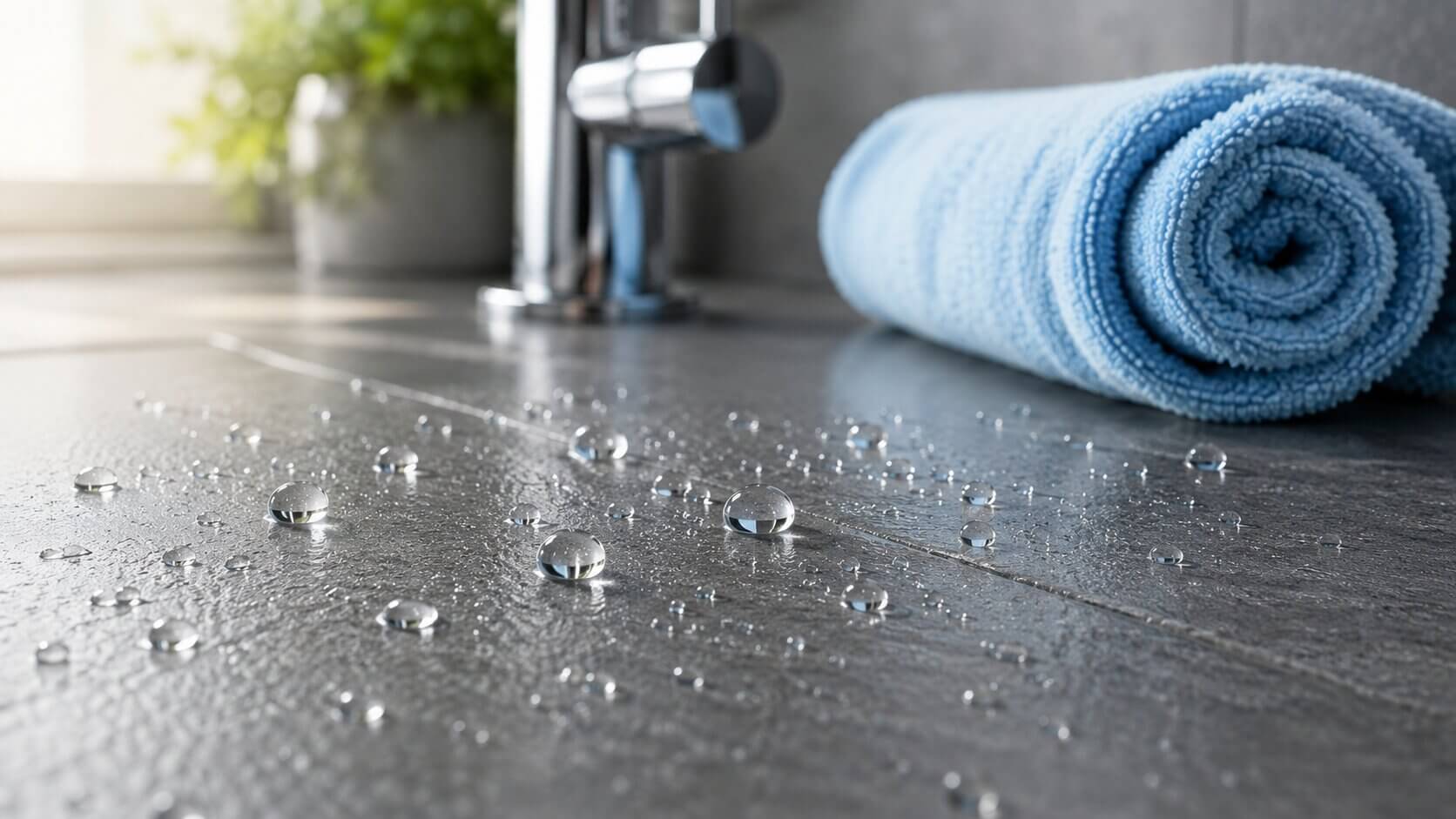
| Bathrooms, tiles, sinks, taps, sanitary surfaces | Removes daily marks, but water spots, soap residue, and limescale start returning after use. | Clean first, then protect sanitary surfaces so water and dirt have less grip. | EcoClean for routine cleaning and EcoCare for interior and sanitary surface protection. | EcoCare is not for glass. Use EcoGlass or EcoGlass Protector for glass, mirrors, and shower glass. |
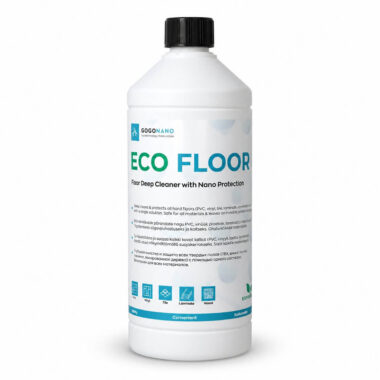
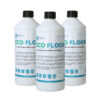
| Hard floors in offices, studios, clinics, shops, and corridors | Mopping removes dirt, but traffic marks return fast near entrances and shared routes. | Use a low-foaming floor cleaner that cleans and leaves a light protective nano layer during routine washing. | EcoFloor for sealed hard floors such as laminate, varnished wood, vinyl, PVC, and tile. | Do not use on untreated natural wood or floors finished with oil-based varnishes. Check floor manufacturer guidance for wet cleaning. |
| Heavy limescale on taps, tiles, shower glass, and wet areas | General cleaners may polish around the problem but do not fully break down mineral deposits. | Use a descaler that removes mineral buildup and leaves a protective nano layer, so future limescale and dirt attach less strongly. | EcoDescaler for calcium deposits, limescale-prone hard surfaces, and easier follow-up cleaning. | Avoid natural stone and test sensitive surfaces first. Rinse or wipe as directed if product starts drying. |
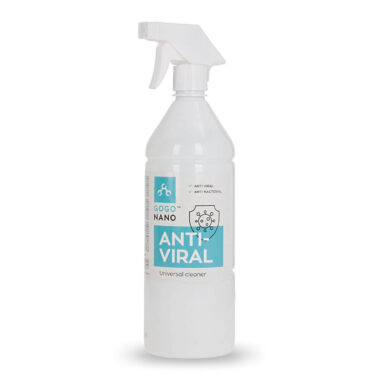
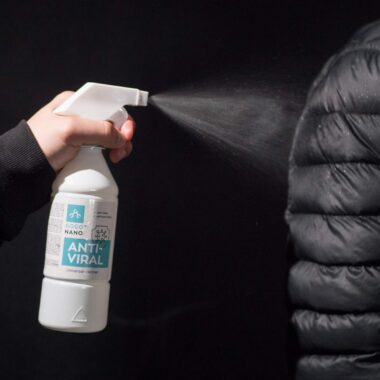
| Higher-risk hygiene situations | Routine cleaning may not be enough after illness, outbreaks, or heavy shared use. | Clean first, then use a dedicated disinfectant only where disinfection is needed. | GoGoNano Anti-Viral for supported disinfection use cases. | Always follow the disinfectant label, required wet contact time, and surface suitability instructions. |
Safer cleaning also means fewer unnecessary products
Small businesses often inherit a messy cleaning cupboard: one strong-smelling glass cleaner, one bathroom spray, one floor product, one mystery bottle under the sink, and a few nearly empty products nobody remembers buying. That is not only inefficient. It also creates safety and storage problems.
The air-quality angle is practical, not abstract. The EPA notes that some cleaning products can be associated with eye, skin, or respiratory irritation, and that VOCs in cleaning products can affect indoor air quality. In a small office, salon, clinic, or studio, people are close to the surfaces being cleaned. Strong odors and unnecessary chemical variety are not just a storage issue; they affect the working environment.
The practical answer is simplification. Choose products that match the actual workplace surfaces, avoid overlapping chemicals for the same job, and let microfiber cloths and mops do part of the work. Do not mix cleaning chemicals, and store products clearly so a new employee or occasional contractor can follow the system without guessing.
It is also worth being honest about environmental language. “Green”, “eco”, and “natural” can be too vague on their own. The European Commission has introduced rules against vague environmental claims that cannot be demonstrated, with EU countries required to transpose the directive by 27 March 2026 and the rules applying from 27 September 2026. For buyers, the useful question is not whether a label sounds green. It is what the product actually avoids, what documentation supports the claim, and whether it works well enough to reduce repeat cleaning.
This is where GoGoNano’s formulation choices matter. Many products in the home series are water-based, PFAS-free where stated, and built around specific surface-care functions rather than vague “green” language. That already aligns with the stricter European expectation for evidence-backed environmental claims: businesses can make ESG (Environmental, Social, and Governance) choices based on actual chemistry, surface suitability, and reduced repeat cleaning, not just marketing labels.
How to build a small business cleaning system
The easiest system is the one people can remember. Start with the five steps below, then adjust them to your business type.
1. Map the surfaces people touch most
Walk through the workspace as a customer and as an employee. Note the entrance handle, reception counter, card terminal, meeting table, bathroom door, tap, toilet flush, coffee machine, fridge handle, shared keyboard, and any glass surface people touch without thinking.
2. Separate daily cleaning from deeper maintenance
Daily cleaning should be short and reliable. Deeper cleaning belongs weekly, monthly, or quarterly. If the daily list becomes too long, people stop doing it. Keep daily tasks focused on high-touch points, visible dirt, bathrooms, kitchens, and customer-facing areas.
3. Use the right cloth system
Use separate microfiber cloths for bathrooms, kitchens, glass, desks, and floors. A color system helps prevent cross-use between clean zones and dirtier zones. Keep the rule simple: do not use bathroom cloths on kitchens or glass, and avoid fabric softener because it can clog microfiber and reduce cleaning performance.
For cloth selection by material, weave, and use case, the microfiber cloth buying guide covers those details. For washing temperatures, drying, detergent choice, and softener mistakes, see the microfiber washing guide.
4. Protect the surfaces that keep creating work
If the same glass door, sink, tile wall, desk, or entrance floor always looks dirty first, treat it as a priority surface. Clean it thoroughly, then use the correct protector or clean-and-protect product. That is where the time saving becomes visible.
5. Make the routine easy to hand over and review
Small businesses often rotate cleaning between an office manager, a team member, a part-time cleaner, or an outside contractor. A simple product system reduces training time because the routine becomes repeatable: this product for glass, this product for sanitary surfaces, this product for floors, these cloths for this area.
Keep the routine visible, short, and specific enough that someone can follow it when the usual person is away. Once a month, check which products run out fastest and which surfaces still cause complaints. If the team is still scrubbing the same bathroom tiles, glass doors, or entrance floors every week, the maintenance method may need adjusting.
Example cleaning kits by business type
Every business has a different layout, but most small workplaces can start with one of these simple kits.
Small office or agency
A small office or agency usually needs a compact routine for desks, handles, shared kitchen surfaces, meeting-room glass, and sealed hard floors. EcoClean covers most non-glass hard surfaces, EcoGlass handles windows and interior glass, EcoGlass Protector is useful where fingerprints or water marks return quickly, and EcoFloor keeps sealed hard floors easier to maintain.
Clinic, salon, studio, or treatment room
A clinic, salon, studio, or treatment room usually has more sanitary surfaces and more customer-facing mirrors or glass. EcoClean works for hard furniture, counters, handles, and washable non-glass surfaces. EcoCare becomes more important around sinks, tiles, and sanitary areas where water and residue repeatedly collect. EcoGlass and EcoGlass Protector keep mirrors, partitions, and display glass clearer between full cleaning sessions. Anti-Viral belongs only where the hygiene situation calls for supported disinfection rather than routine cleaning.
Retail, showroom, or customer-facing office
A retail space, showroom, or customer-facing office lives or dies by first impressions. Glass, display surfaces, counters, card terminals, and entrance floors are the surfaces customers see and touch first. EcoGlass and EcoGlass Protector should sit at the center of the routine, with EcoClean for counters and hard touchpoints and EcoFloor for high-traffic sealed hard floors.
Procurement: make reordering boring
A good cleaning system should not depend on someone remembering a random product name from a supermarket shelf. For small businesses, procurement is part of the system.
Build a standard kit, decide who checks stock, and reorder before the last bottle is empty. For most small offices and business spaces, the core kit is simple: one product for most non-glass hard surfaces, one for glass cleaning, one glass protector for surfaces that should stay clearer for longer, one sanitary protector for bathrooms and wet areas, one floor cleaner for sealed hard floors, one descaler that removes mineral buildup and leaves a protective nano layer, and one dedicated disinfectant for situations where routine cleaning is not enough.
Buying larger pack sizes can make sense when the product is used regularly, but the bigger saving is usually operational: fewer wrong purchases, fewer half-used bottles, less confusion for staff, and less repeat cleaning on surfaces that could have been protected after the first clean.
That is the quiet operational gain: fewer decisions, clearer use, easier reordering, and less time spent fixing the same cleaning problem.
FAQ: office cleaning for small businesses
What is the best office cleaning checklist for a small business?
The best checklist separates daily, weekly, monthly, and quarterly tasks. Daily tasks should focus on high-touch surfaces, bathrooms, kitchens, reception areas, shared equipment, and visible floor dirt. Weekly tasks should cover glass, shelves, deeper bathroom cleaning, and floor washing. Monthly tasks should include dust traps, vents, skirting boards, limescale checks, floor condition, and product inventory. Quarterly tasks are for deeper descaling, exterior-facing glass, floor condition reviews, high dust areas, and cleaning-routine handover.
How often should office high-touch surfaces be cleaned?
High-touch surfaces should be cleaned at least daily in most small offices and more often in high-traffic customer-facing spaces. Focus on door handles, switches, reception counters, card terminals, taps, toilet flushes, coffee machines, shared desks, keyboards, and appliance handles.
Do small offices need disinfectant every day?
Not always. Routine cleaning is the foundation because it removes dirt and many germs from surfaces. Disinfection is most useful when someone has been ill, during outbreaks, or in hygiene-sensitive shared areas. When you disinfect, clean first and follow the product label, surface suitability, and required wet contact time.
Can EcoCare be used on office glass or mirrors?
No. EcoCare is for interior and sanitary surfaces such as tiles, sinks, bathroom surfaces, kitchen surfaces, doors, shelves, and other hard non-glass materials. For glass, mirrors, windows, glass doors, and partitions, use EcoGlass for cleaning and EcoGlass Protector for glass protection.
How can a business reduce window and glass cleaning frequency?
First clean glass properly with a dedicated glass cleaner and a clean low-lint microfiber cloth or squeegee. Then apply a glass protector to clean, fully dry glass where appropriate. The protection helps water, fingerprints, and dirt attach less strongly, so routine wipe-downs become easier and full glass cleaning may be needed less often.
Can EcoFloor be used on all office floors?
EcoFloor is suitable for sealed hard floors such as laminate, varnished wood, vinyl, PVC, and tile. Do not use it on untreated natural wood or floors finished with oil-based varnish. Before wet cleaning any floor, check the floor manufacturer’s guidance and test if you are unsure.
What cleaning products should a small office keep in stock?
A practical small office kit can use home-care products when they match the surface and the level of traffic. It usually includes an all-purpose hard-surface cleaner, a dedicated glass cleaner, a floor cleaner for the actual floor type, a sanitary surface protector, a glass protector for problem glass surfaces, a descaler with nano protection for mineral buildup, a disinfectant for higher-risk hygiene situations, and separate microfiber cloths or mops for each zone.
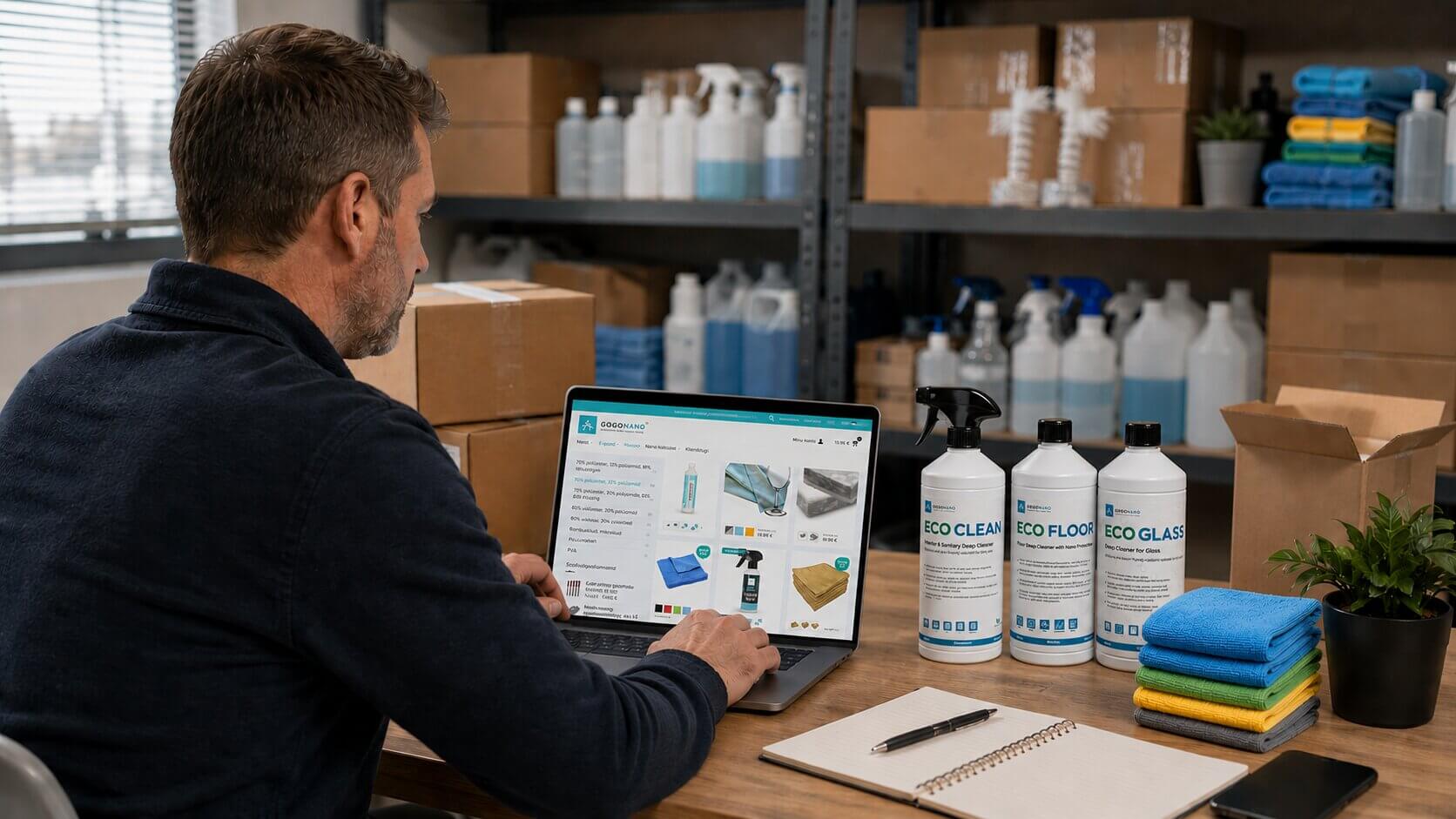
Where GoGoNano fits in the office cleaning routine
GoGoNano is not trying to make office cleaning complicated. The practical standard is simple: clean what is dirty, protect what keeps getting dirty, and use the right product for the material. For many small businesses, the repeat-work surfaces are hard touchpoints, glass, bathrooms, and floors, so start there and build a simple clean-and-protect kit around the surfaces that create the most work.
If you reorder regularly, buy in bulk, or manage cleaning supplies for a team, register for a GoGoNano business account. Approved B2B accounts can access wholesale pricing, volume discounts, simplified reordering, and product support. Applications are typically reviewed within 2-3 business days.
Apply for a GoGoNano business account Compare surface care products

 Single product
 Pack of 3
 Pack of 6
 Pack of 12 / Full box
Floor Cleaning
 Single product
 Pack of 3
 Pack of 6
 Pack of 12 / Full box
Surface Disinfectants
 Single product
 Pack of 3
 Pack of 6
 Pack of 12 / Full box
All-Purpose Cleaners


 Single product
 Pack of 3
 Pack of 6
 Pack of 12 / Full box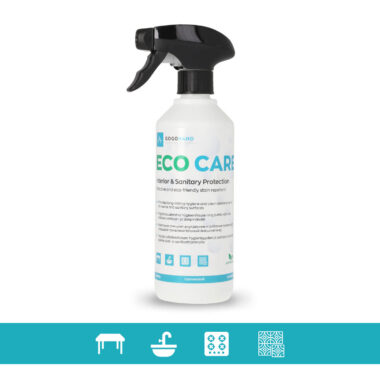
 Single product
 Pack of 3
 Pack of 6
 Pack of 12 / Full box
Nano Protectors
 Single product
 Pack of 3
 Pack of 6
 Pack of 12 / Full box
Glass & Window Cleaners
 Single product
 Pack of 3
 Pack of 6
 Pack of 12 / Full box
Nano Protectors

Latest articles
Useful
How to Choose the Right Refillable Sprayer or Spray Can
A practical guide to choosing a refillable sprayer by mechanism, capacity, reach, nozzle, bottle fit and chemical compatibility, with a product selector.
Read moreUseful
How to Clean a Car Interior Safely: Plastic, Fabric, Leather, Screens and Glass
A practical material-by-material method for cleaning dashboards, displays, seats, carpets, glass and trim without excess moisture, harsh scrubbing or avoidable surface damage.
Read moreUseful
How to Choose a Mop for Your Floors and Cleaning Routine
A practical mop selection guide for hard floors, homes and offices. Compare manual and powered systems, moisture control, head width, pad fit and lifetime cost before buying.
Read moreUseful
How a Melamine Sponge Works, Where to Use It and What to Avoid
Melamine sponges can erase marks with water alone, but their fine abrasive action is not safe for every finish. Learn how they work, how to test a surface, what to[...]
Read moreNews
GoGoNano Affiliate Program is now open
GoGoNano's affiliate program is now open for responsible creators, customers, bloggers, publishers and partners who want to recommend practical surface-care products.
Read moreNews Product overviews
GoGoNano Business Accounts: B2B Pricing for Cleaning, Surface Care and Resale
GoGoNano B2B accounts help cleaning companies, car detailers, facility teams, offices, hotels, resellers and distributors access eligible business pricing, repeat ordering and product support.
Read moreUseful
How to Waterproof a Jacket: Restore DWR and Diagnose Leaks
Restore your jacket's water repellency at home: diagnose wetting out, clean and reproof the outer fabric, and avoid mistakes that damage seams, zips or membranes.
Read moreUseful
How to Wash Your Car at Home Without Scratching the Paint
Most car wash scratches come from rubbing loose dirt into the paint — not from washing itself. This guide covers the two-bucket method, the right microfiber tool for every surface,[...]
Read more